1. Select a discrete app icon.








notes

Note: In this article’s title, we use the phrase “abusive relationship” because it’s a common term people search for when looking for information about domestic violence, domestic abuse or intimate partner violence. At DomesticShelters.org, we aim to use language that accurately reflects that abuse is a choice made by the person who harms—not a mutual dynamic and never something the survivor is to blame for.
It’s the moment of truth: stay or go. For many survivors of abuse, this crossroads comes after the final boundary has been crossed—when the danger feels undeniable, hope for change has faded, the children have been harmed, or a survivor begins to lose sight of who they are. But it’s never an easy choice, which survivor Anna Lee can attest to.
“I was not really planning on leaving. I had no family around and I really felt trapped.”
Even after talking to a domestic violence advocate at her local Family Justice Center, she went home, fully prepared to return to her abusive partner and tough it out. The partner who had physically beat her, blamed his abuse on her—which had resulted in her arrest and subsequent eviction from her own home—and who had been keeping her from seeing her two young children.
Even then, says Lee, “I was thinking of all the reasons I couldn’t escape. I really wanted to get out of the situation, I just didn’t know how I would survive.”
Fortunately, that didn’t end up being Lee’s future.
For anyone standing on the edge of leaving—uncertain, afraid or unsure where to begin—let this guide be your first step forward.
Finding support is your first step toward leaving an abusive partner. It may feel intimidating to tell a stranger the personal details of your relationship, especially when abuse often carries with it unnecessary shame and self-blame. Try to remember, those are things you don’t deserve to carry. An abusive partner often tries to make the survivor feel like she’s to blame for what’s going on. The abuser might accuse her of “being dramatic” in order to shame her into silence. An abuser may also threaten additional harm toward her, children, pets or other family members if she discloses.
Tell someone anyway. You need support to leave.
Reach out to your nearest domestic violence advocacy organization or Family Justice Center and speak to someone who is there to help. Like Lee, you may be convinced you’re trapped.But they may know ways out that you’re not even aware of.
You may also want to consider speaking to a lawyer, but make sure you choose one who has experience in helping domestic violence survivors. See the following articles for more information:
A safety plan is a written contingency plan that accounts for anything the abuser may do to stand in your way of leaving and what you can do in response. It plans out when is the safest time is to leave for you, and where you’ll go (like a friend, shelter or another housing option). A safety plan helps you organize your thoughts on what you need to pack and what documents you need to compile in order to protect yourself financially and legally.
A domestic violence advocate can help you assemble your safety plan. Taking the time to do this can help ensure that you don’t feel compelled to return to the abuser for any reason.
There are instances where there isn’t enough time to make a safety plan. Sometimes, survivors are in imminent danger and need to leave immediately. In those cases, it’s more important to get out with your life and just worry about everything else later.
For Lee, she says it was a “leap of faith” that allowed her to take this next step with her advocate. Within hours of making the decision that she was ready for his abuse to end, she was back at the Family Justice Center and steps two and three were in motion.
You can read these articles to start your safety plan:
An order of protection, sometimes also called a protection order or restraining order, shows the abusive partner that you're serious about the relationship coming to an end. It will criminalize any contact the abuser tries to have with you—even a simple text message can be a violation that can result in arrest. This gives you the space and time to find a safe place or, in some cases, ask the judge to evict your partner from a shared home.
In Lee’s case, the judge decreed her abusive husband needed to vacate the home they shared and that she was allowed to move back in and take care of their children. Her husband was only allowed to come back with a police escort to retrieve his belongings.
Learn more about orders of protection:
Financial abuse is a tactic almost all abusive partners will utilize to control their partners. Abusers utilize financial abuse in 98 percent of domestic violence cases. It’s the most common reason survivors stay with or go back to abusers. By controlling the money, restricting finances, forbidding their partner from holding a job or forcing a partner to turn over any money they make, the abuser ensures their partner is financially dependent. Without financial support, leaving seems next-to-impossible for most survivors.
With Lee’s ex withholding their joint money, she relied on her church for assistance with rent at a new apartment she could afford until she could find a job. Her local Family Justice Center helped her fast-track an application for SNAP benefits so she could feed her children.
“He didn’t add any money to my account,” says Lee. She remembers advocates telling her there would be days when she would be tempted to go back, “but those are the days to push back and get through,” she remembers them saying. After all, money can be replaced; safety can’t. For Lee, that made the choice clear, even when it wasn’t easy.
If there’s time, getting finances in order before leaving an abusive partner will make the escape process easier on yourself and your children. Even if you don’t have access to shared money, don’t have a job and are without family support, it doesn’t mean the situation is hopeless. There are people and advocacy groups out there that can help.
Find more financial support information and resources:
As disheartening as this sounds, it’s unfortunately the truth in most cases of domestic violence. Leaving an abusive partner is rarely the end of the abuse. Expect there to be post-separation abuse as your now ex-partner has realized they’ve lost control of you. In many cases, this type of abuse may even look like an escalation from when you were together. The abuser may threaten additional harm if you don’t come back, including threats to harm or kill you, himself, your children, pets or other family members. It’s important to never underestimate what an abuser is capable of when he is losing control of his victim.
A survivor should report each incident of harassment, stalking and threats to law enforcement and a lawyer. They should be violations of the order of protection. In all 50 states, stalking is illegal and should be prosecuted as such.
To learn more about post-separation abuse, read:
After separating from an abusive partner, you’ll want to consider a fresh start in more ways than one. Depending on how relentless the abuser is in continuing their harassment and control, you may want to erase as many parts of your former life as possible. This means deleting social media accounts, resetting all passwords, getting a new cell phone and phone number if possible, and even relocating to a new address, if you can. Whatever it takes to make it harder for your ex-partner to find you, the better chance you’ll have of them leaving you alone.
Your support gives hope and help to victims of domestic violence every day.
There is a chance an abuser has put spyware on your devices that can track both your location and your online activity. They may be able to see the websites you visit, read your emails and text messages, even listen in on phone calls. Some digital stalking methods even allow perpetrators to remotely control a victim’s smart devices, like Ring cameras, home thermostats and car GPS systems.
Read more about ways to better protect yourself online:
Lee says it was “heartbreaking” to move herself and her children seven years ago from their familiar home to an apartment that she says, “wasn’t in the safest area, but it was all I could afford.” But she knew it was their only option, and she wasn’t about to return to her abusive ex.
“I knew my situation was very urgent and I needed to take action. Around this same time, a woman in Korea in a very similar situation to mine was pushed down the staircase by her husband and died.” When Lee saw the story on the news, she thought, what if that was her?
“I couldn’t leave my babies behind,” she says. That news story was the wake-up call Lee needed, and the next day, she told her advocate at the Family Justice Center she was ready to do whatever it took to get free from her abusive husband.
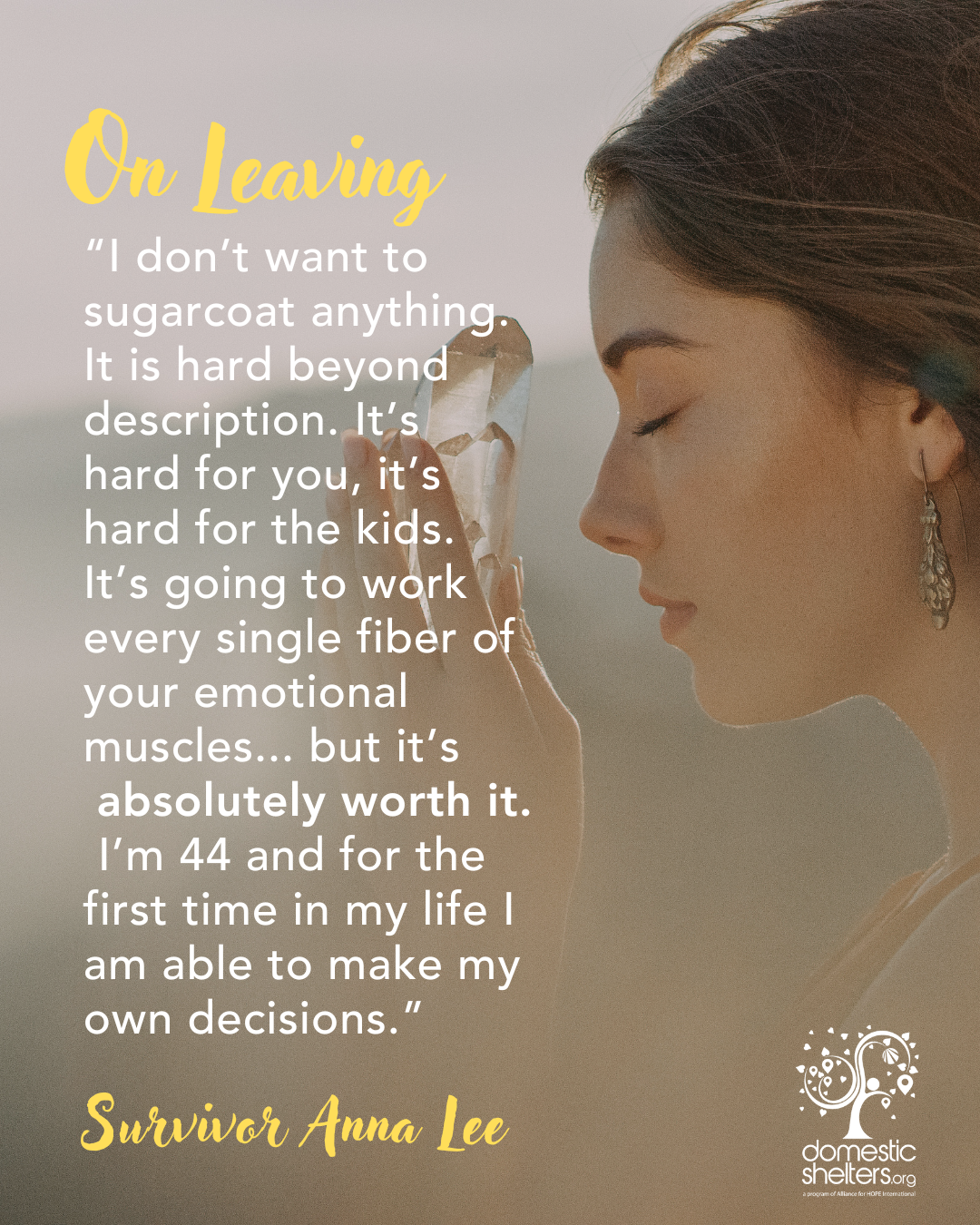
“I don’t want to sugarcoat anything,” she says. “It is hard beyond description. It’s hard for you, it’s hard for the kids. It’s going to work every single fiber of your emotional muscles. There are still ongoing issues, but it’s absolutely worth it. I’m 44 and for the first time in my life I am able to make my own decisions.”
Keeping the hope during the separation and healing process from an abusive partner may take years. Don’t let anyone make you feel like you should be OK just because you’re able to leave the house or file for a divorce. The process of separation can be long and arduous, but remind yourself everyday why you’re doing it—you deserve to feel safe. Your children deserve safety.
Learn more about healing after domestic violence:
Hear more of Anna Lee’s story in her own words in Episode 2 of Alliance for Hope’s new VOICES of Hope podcast, now on YouTube or wherever you listen to podcasts.

Welcome, this is your discreet connection to help.
You are safe here.
Menstruation is an experience shared by
generations of women across the globe.
Sadly, abuse is another commonly shared experience between women.
Be it physical or psychological, abuse is not OK in any form.
Period.
You are not alone.
Help is just a few clicks away.
Welcome to DomesticShelters.org, a trusted Bright Sky US partner. On DomesticShelters.org, you will find free domestic violence resources such as:
The Bright Sky US website is still open on your browser in a separate tab, so you can return to the Bright Sky US website anytime.


