1. Select a discrete app icon.








notes
This piece was originally published in 2015. It was updated in 2026.
Many domestic abuse survivors find themselves navigating the court system at some point. This often comes right on the heels of trauma—after an abuser is arrested, when the survivor is seeking safety through a protection order, during a divorce or when seeking child custody after separation.
Facing the court process alone can feel overwhelming. But, a knowledgeable attorney can be an invaluable ally, helping you understand your rights and avoid costly missteps.
However for many survivors, finding an attorney who understands domestic violence and doesn’t come with a crushing price tag is its own challenge. Affordable, survivor-informed legal aid can be hard to find. That gap keeps too many people from getting the protection and justice they deserve.
It’s not always clear when a domestic violence lawyer is necessary, or how to find one who understands the complex dynamics of abuse. This article breaks down the signs legal help may be needed and how to choose a lawyer who can support both your safety and your case.
There are times as a domestic violence survivor where you may question if you need a lawyer. We'll go through some of these situations and cover what experts advise.
Yes, family and domestic court is where representation by an attorney is crucial, particularly if the abusive partner has a lawyer. You’ll want to retain legal counsel when filing for divorce or child custody, working out a parenting agreement (i.e., arranging safe custody exchanges), as well as dividing assets (e.g.,deciding who gets to stay in the shared home).
Many protective mothers walk into custody court expecting the system to protect them and their children. Unfortunately, those expectations often collide with a very different reality. Many survivors have told us they expected to be able to explain the abuse their partner inflicted to a judge and the court would protect their children. The opposite happened.
This is why it’s even more important to find a lawyer with experience representing domestic violence survivors.
Learn more about escaping domestic abuse with children.
You can petition the court for a protection order (also called a restraining order) without an attorney. The process varies by jurisdiction, but generally involves going to the courthouse, filling out paperwork and then providing sworn testimony in front of a judge.
Some jurisdictions allow you to begin the paperwork online or at home, so check your court’s website to save time. If you have questions or would like assistance with the process, you can ask to speak with a court/victim advocate or contact a local domestic abuse program. Family Justice Centers often have space on-site where you can get support to complete the process, including meeting with a judge virtually.
Learn more in our guide on restraining orders.
If an abusive partner is arrested for committing a crime against you, you do not need to hire a lawyer to press charges. A city or state prosecutor or district attorney will handle your case, depending on the jurisdiction.
A note about “pressing charges”: If an abuser is arrested for a domestic violence crime (assault, threats, stalking, etc.) against someone who fits the definition of a domestic violence relationship (current or former intimate partner, family member, roommate, etc.) then you won’t get to decide if you want to press charges or not. The prosecutor will decide for you. This is because courts know that domestic violence survivors are fearful of abusers and are often threatened into not pressing charges. So the law has removed the victim’s discretion in such cases.
In other words, an abuser can be prosecuted, tried and sentenced without your participation. However, it’s much more likely for an abuser to be convicted of a domestic violence crime if you cooperate with prosecutors. Many times, abusers will try to coerce a victim into recanting their statement to police using manipulative or threatening tactics (i.e., witness tampering, which actually constitutes an additional crime).
Sometimes, police can’t determine who the primary aggressor is when they respond to a domestic violence call.
Sometimes this means both the abuser and victim are arrested. In other cases, a victim may act in self-defense, and the abuser uses this to play the victim, with police believing them. In this case, yes, you should ask to call a lawyer and comply with police. If you’re unsure of who to call, reach out to your nearest Family Justice Center or domestic violence program, which can help you find legal help. To learn more, read “I Got Arrested Too. Now What?”
The fear of being arrested should not deter you from calling police for help. You have the right to defend yourself, and your life and safety are the most important priorities. For more information on how to best respond when police are called, see “How Police Are Trained to Respond to Domestic Violence.”
The first thing to understand is that, as a survivor, “You do not have to tell your whole story to ‘earn’ help,” says Michellene Burke, associate member of the American Bar Association and a certified Narcissistic Abuse Treatment Clinician who counsels survivors leaving abusers and entering the family court system. A lawyer is not a therapist. Spilling every detail of your story could actually work against you in this scenario.
“The lawyer may think they’re too emotionally dysregulated. It could be seen in a way that may not be helpful [to the case].”
Instead, Burke, who is also a court-appointed mediator specializing in domestic violence and juvenile and domestic relations, recommends survivors—often scared and exhausted, and afraid of not being believed—prepare a script before calling. This can help you stay focused and calm.
She helped us prepare this example script survivors can use.
1. Intro: “Hi, my name is [Name]. I’m looking for some assistance and legal guidance related to a few potential domestic violence situations I've experienced that may need me to go into (family court / criminal court / both).
Before I share details, I wanted to ask a few quick questions to see if we’d be a good fit and to understand your approach to safety in domestic violence cases.”
If you’re nervous, says Burke, say so.
“I’m a little nervous making these calls, so please bear with me.”
2. 30-second “snapshot”: “Here’s where things stand right now…. “
Let them know whether:
3. Name the pattern in one sentence: “There’s been a pattern of intimidation and control going on for [number of months/years] that escalated after [separation/filing for divorce/a change in circumstances/having children].” Name the pattern in one sentence: “There’s been a pattern of intimidation and control going on for [number of months/years] that escalated after [separation/filing for divorce/a change in circumstances/having children].”
Adjust this according to your own specific circumstances.
4. List two to three of the most serious events (headlines only): “He’s been stalking me for the last six months. He strangled me in front of my children. He has threatened to take my children away from me if I don’t come back.”
Adjust this according to your own specific circumstances. Note if these incidents have escalated in frequency or severity.
5. Make your ask: "What I need in the next one to two weeks is safe exchanges, hearing preparation, filing help and guidance on next steps.”
Again, change this to fit what you specifically need.
Remember, says Burke, you don’t have to make a decision on the phone. The lawyer may try to pressure you to decide quickly what you want to do. But, you do not have to.
“The goal is to have someone to represent you without recreating any toxic patterns inside the court process,” says Burke. This may mean making more than a few calls to different attorneys.
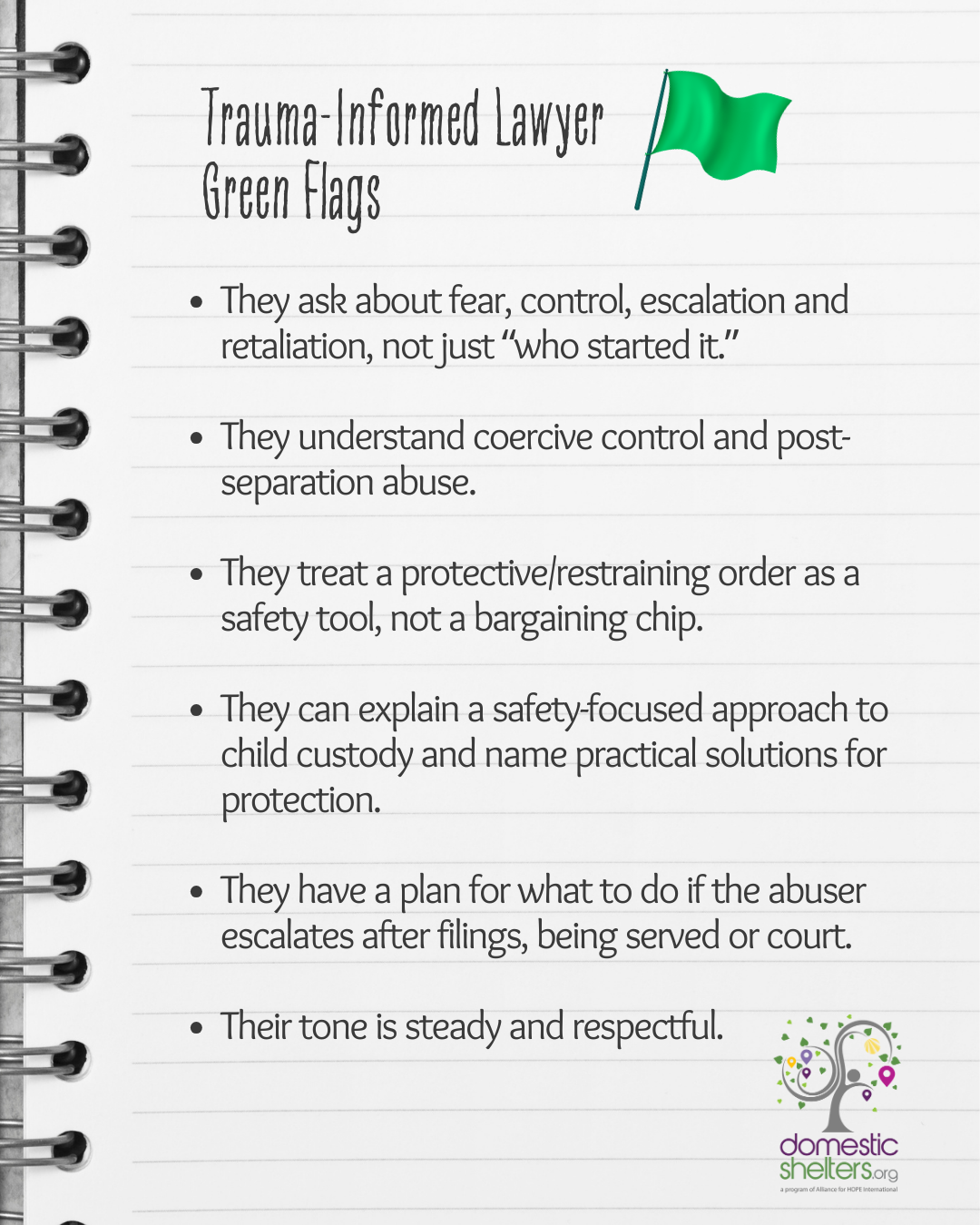
Burke recommends looking for the following green flags from lawyers that would more likely indicate they’re trauma informed:
On the other end of the spectrum, Burke recommends survivors stay away from lawyers that display the following:.
It’s important to prepare for the charges you may incur when hiring a lawyer. You may be fortunate enough to find a lawyer who is taking on cases pro bono, but these are few and far between.
Low-cost lawyers may be available for some cases, but you need to be careful here, too. If you use a lawyer who isn’t familiar with the complexities of domestic violence and how abusers can use the court system to continue to torture, manipulate or control their partner, you could find yourself in an even worse situation.
Many lawyers charge a consultation fee to meet for the first time and discuss your case, the plan of action they recommend and how the lawyer might help you. After that, there may be a retainer fee, which is basically a down payment for lawyer’s services (future fees are deducted from this amount). If you choose to end services with the lawyer at any time, the remainder of the retainer should be refundable.
There’s a possibility your attorney will charge a flat fee for your case. This will be the easiest and likely least stressful way to prepare for what you’re going to owe. For instance, a divorce might cost $1,000 unless it’s contested, in which case, it may jump up to $5,000.
Otherwise, you’ll likely pay for the attorney’s time on an hourly basis, which includes work done inside and outside the courtroom. Hourly rates can vary widely, from $150 on the low side to over $500 on the high side. You may be billed separately for paralegal or legal secretary assistance as well.
Divorce is more affordable in some states than others. Read “After Abuse, a High-Priced Divorce Is the Next Trauma” for more information.
Burke says she highly recommends personal recommendations as the best way to find reputable domestic violence lawyers. However, it is not always safe to start asking friends and family members for lawyer recommendations.
When considering a divorce or separation, Burke cautions survivors to be careful about who they tell. Leaving is notoriously a dangerous time for survivors, and this information may be something you want to keep private until you have a safety plan and legal representation.
Instead, consider joining a local Facebook mom’s group where you may be able to post questions anonymously. You can also reach out to your local domestic violence agency or Family Justice Center and ask for attorney recommendations.
The following online resources can help point you in the right direction as you navigate the legal system. Keep in mind that ‘legal aid’ may not always mean securing a lawyer. It may mean advice on one particular area of the legal system. This could include advice on how to represent yourself in court, fill out forms or file certain motions, get restitution (financial compensation for damages/injuries) or answer other questions you have.
Family violence doesn’t end when a relationship ends—it often escalates in courtrooms, custody disputes and financial negotiations. Domestic violence law exists to address that reality, but only when it’s applied with an understanding of coercive control and retaliation.
If you’re entering the legal system, you shouldn’t need to ask permission to be believed—safety should be guaranteed. And that begins with legal representation that recognizes abuse for what it is and plans accordingly.
You don’t have to figure this out alone. An advocate can help you find safety—connect with one today through our Get Help page or by using Hope Chat, available at the bottom of your screen on DomesticShelters.org.
Your support gives hope and help to victims of domestic violence every day.

Welcome, this is your discreet connection to help.
You are safe here.
Menstruation is an experience shared by
generations of women across the globe.
Sadly, abuse is another commonly shared experience between women.
Be it physical or psychological, abuse is not OK in any form.
Period.
You are not alone.
Help is just a few clicks away.
Welcome to DomesticShelters.org, a trusted Bright Sky US partner. On DomesticShelters.org, you will find free domestic violence resources such as:
The Bright Sky US website is still open on your browser in a separate tab, so you can return to the Bright Sky US website anytime.


