1. Select a discrete app icon.








notes
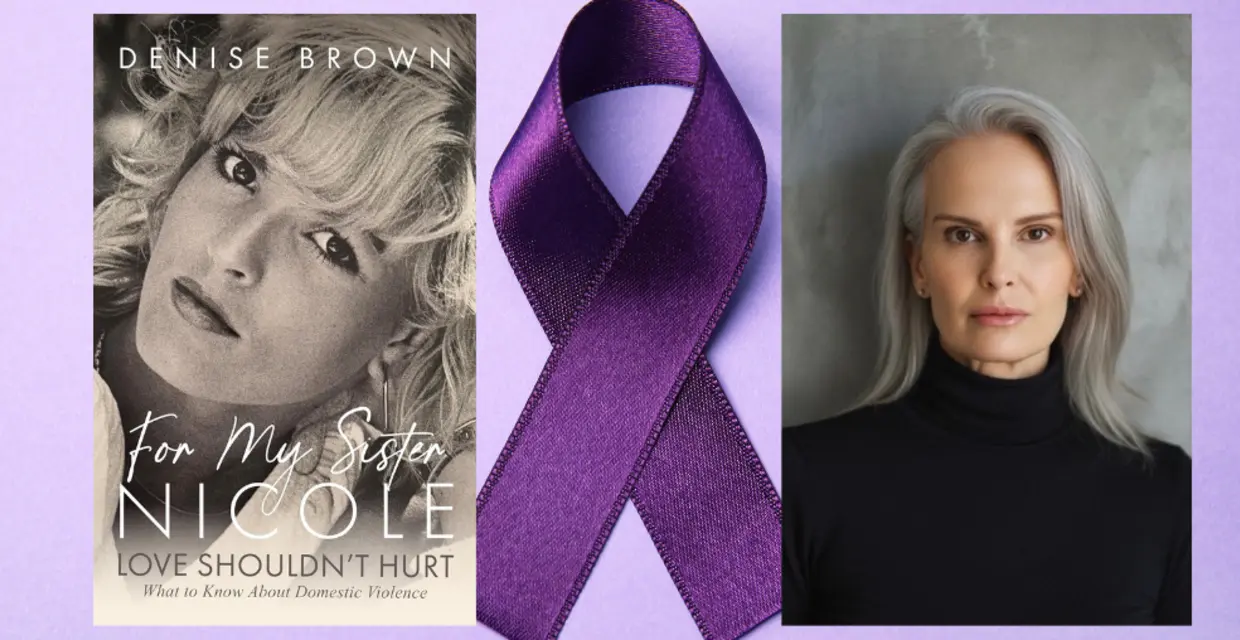
In the ’90s, O.J. Simpson was the kind of celebrity America seemed to have collectively decided was one of the good guys. He was a star football player who became an actor, a pitchman and a familiar face in living rooms across the country. Outwardly, he was charming, funny and successful. He had a beautiful wife, Nicole Brown Simpson, and two adorable children.
But behind closed doors was a very different version of O.J. When it became public that he had been physically abusing Nicole, many people struggled to reconcile the allegations with the man they thought they knew. And when Simpson was arrested in 1994 and charged with murdering Nicole and her friend, Ron Goldman, people famously rallied around him, with thousands lining the streets as he fled from police in a white Ford Bronco.
Nicole’s family knew a different side of Simpson. They knew Nicole was afraid of him, even after their divorce. What they could not know was how far that fear would ultimately extend, or that the abuse they had witnessed and worried about would end with Nicole’s murder.
That uncertainty has stayed with Nicole’s sister, Denise Brown, for three decades. Now, for the first time, she has put much of what she has learned into a book. For My Sister Nicole: Love Shouldn’t Hurt—What to Know About Domestic Violence, released during Domestic Violence Awareness Month, draws on journals Nicole left behind, detailing aspects of O.J.’s abuse that Denise had never been privy to. It also draws on Denise’s decades of advocacy, conversations with survivors and advocates, and her own experience learning just how complicated domestic violence can be.
The book is not simply another retelling of one of the most infamous murders in American history. Brown wants readers to understand what can happen long before an abusive partner turns to murder and why recognizing domestic violence isn’t always as straightforward as we might imagine.
Immediately after O.J. was acquitted in the criminal trial for the murders of Nicole and Goldman—though he was later found liable for their deaths in a civil trial—the Brown family started the Nicole Brown Simpson Charitable Foundation. Denise had high hopes for what it could accomplish as tens of thousands of dollars began to pour in. She thought the attention surrounding Nicole’s death could be a catalyst for significant change.
“After we started the foundation, I thought, ‘Oh yay, domestic violence is going to stop!’” Denise says. “That was before I realized how deeply rooted domestic violence actually was.”
In the aftermath of her sister’s death, Denise was given her sister’s journals.
“After her murder is when we found the notes and diaries underneath her kitchen sink. My father brought them home. And that’s when I realized … oh my god,” she says.
What lay inside would haunt her for years to come. She read about the devastating details of O.J.’s abuse in her sister’s own voice, times when O.J. threw Nicole into walls, beat her for hours at a time, locked her in a closet and left her on the side of the road.
Denise remembers blaming herself for not asking the right questions to get the full picture. And, as survivors often do, she even wondered whether something she had done had made O.J. angry.
One of the incidents described in the journals followed a night out where Nicole, O.J., Denise and others dined at a Mexican restaurant, enjoying food and margaritas. Once back at the Simpson home, O.J. demanded Nicole get him more food.
Denise was incredulous. We just ate, she thought, followed by an angry accusation: Wow, you really take her for granted. She does everything for you.
What followed was a wordless, rage-filled O.J. stomping up the stairs, where he began throwing Nicole’s things over the second-floor railing and into the foyer below. Framed family pictures of the Browns soon followed, shattering onto the hard floor. Denise and Nicole looked at each other, confused, frightened and unsure what to do.
That’s when O.J. stormed back downstairs and grabbed Nicole by her neck with Denise watching, shocked. He had her dangling a few inches off the ground as Denise began screaming and pummeling him on his back until he finally threw her to the ground.
Ultimately, Nicole was able to leave with Denise and get to a hotel. Later that night, however, she returned to O.J., calling Denise to excuse his behavior and saying he was just drunk.
Later, Nicole says she asked herself, “Was it my fault? Did I send him into a complete rage?”
She eventually came to know that abuse is a choice an abuser makes. It’s not a normal reaction to anger.
“Once I learned about it, I knew this was not my fault. It was a true education. I thought these were isolated incidents, related to drinking. When you don’t grow up in a household like that, never in a million years did you think someone could treat someone like that.”
Nicole’s journals led Denise to another eye-opening revelation: These incidents weren’t just O.J. “flying off the handle” occasionally. There was a cycle to his abuse, and the times when he wasn’t violent were what led Nicole to have hope, to stay.
“It didn’t happen every day. I didn’t know because I didn’t live with her,” says Denise, who now sees that she oversimplified the solution to Nicole.
“I said all the wrong things to her—you’ve got to get away from him; you’ve got to leave him; what are you doing?”
Nicole did, in fact, want to leave. But as we know, abusive partners don’t make it easy. In 1992, Nicole and O.J. divorced. Then came allegations of stalking and intimidation, along with documented 911 calls.
In October 1993, Nicole called 911 twice because O.J. had shown up at her home. In the first call, she told the dispatcher that her ex-husband had broken into her house and was “ranting and raving” outside. Then she called back less than a minute later: “He’s back. Please.” A recording of the call was later released publicly.
During another 1993 incident, Nicole contacted the Los Angeles city attorney’s domestic-violence unit and reportedly said she was terrified and afraid for her life. Nicole told officers she believed O.J. was going to kill her.
She also alleged that he was following her, watching her home, and finding ways to show up where she was.
At one point, prosecutors said O.J. showed a friend a back way into Nicole’s home and said, “Sometimes she doesn’t even know I’m here.”
It took nine calls to 911 for police to arrest O.J. for domestic assault. He served 200 hours of community service and just two years of probation. Meanwhile, Nicole recorded over 60 incidents of domestic abuse in her journals, which were deemed inadmissible in her murder trial because she wasn’t there to cross-examine.
Stalking increases the risk of intimate-partner homicide threefold. Research has also found that stalking is alarmingly common in the year before an attempted or completed intimate-partner homicide.
For Denise, learning how to recognize those warning signs has been part of the education that came after Nicole’s death.
And one of the most sobering lessons has been about something she witnessed firsthand but didn’t fully understand at the time: strangulation.
Denise now shares with audiences that strangulation is one of the most dangerous forms of domestic violence. It was something she came to understand more deeply through her work with Casey Gwinn, co-founder of Alliance for HOPE International, whose work she discusses in her book. The more she learned from Gwinn and the organization, Denise says, the more she realized how much she, as well as the public, had misunderstood about what happens when an abuser puts their hands around a victim’s neck.
“People can die for up to a year after [being strangled]. Nobody understands that severity at all. It’s something that no one ever really talks about,” says Denise. “I read about strangulation on Alliance for Hope [website]. It’s so much deeper than people actually realize … they say how it’s a precursor to murder. I just sit there and I go wow wow wow. It’s crazy how dangerous strangulation is.”
Research backs up the danger Denise describes. Nonfatal strangulation is considered one of the strongest predictors of subsequent intimate-partner homicide, and victims may suffer serious internal or neurological injuries even when there are few or no visible marks.
It was only after Nicole’s murder that Denise and her mother visited Human Options, an Orange County, California-based domestic violence nonprofit. There, one of the founders, Vivian Clecak, showed Denise the Cycle of Violence, a four-stage pattern that abusive behavior can take–sometimes hundreds of times over. It changed how Denise saw her sister’s relationship.
The pieces clicked together—he wasn’t just a mean guy with a short temper. He was an abuser, and he had Denise’s sister trapped.
It was an eye-opener Denise wanted to share with the world. Unfortunately, she soon found out that domestic violence stories, even those with a celebrity at their center, have a shelf life.
Immediately after O.J.’s arrest, Denise remembers the media being flooded with stories about domestic violence. For a while, it seemed as though the country was paying attention. But eventually, as it does with even the most sensational stories, the attention moved on.
Denise didn’t.
“I think domestic violence should be talked about every single day because of the severity of it,” she says. “Because people end up dead.”
Over time, sitting in on court hearings and talking to advocates and survivors, she came to feel the same frustration many others have felt with the court system.
“I think the system fails people because the system doesn’t understand domestic violence. Jurors need to be educated on domestic violence. And if the victim is a woman, they’re labeled ‘too emotional.’ You [the survivor] cry; you have feelings. They [jurors] see that. And the criminal is standing in the courtroom in a three-piece suit, very put together. And has charm. And that I think is the difference.”
What may be the most uncomfortable lesson of Nicole’s story: Domestic violence doesn’t become less serious because the person accused of committing it is famous, talented, wealthy or beloved.
We’ve seen it in the intensely polarized public reaction to Johnny Depp and Amber Heard. We’ve seen Chris Brown’s continued popularity despite his 2009 assault of Rihanna and subsequent allegations of violence. And professional sports have repeatedly faced the uncomfortable reality that some of the athletes their fans cheer for have also been accused of violence against intimate partners.
At least 134 NFL players have been arrested on domestic violence charges since 2000, according to figures drawn from the USA TODAY NFL arrest database. The database cautions that its records, compiled from media reports and public records, cannot be considered fully complete.
The details of each case are different, and allegations, arrests and criminal convictions are not the same. But the broader question remains remarkably consistent: What happens when the person accused of abusing a partner is someone we admire?
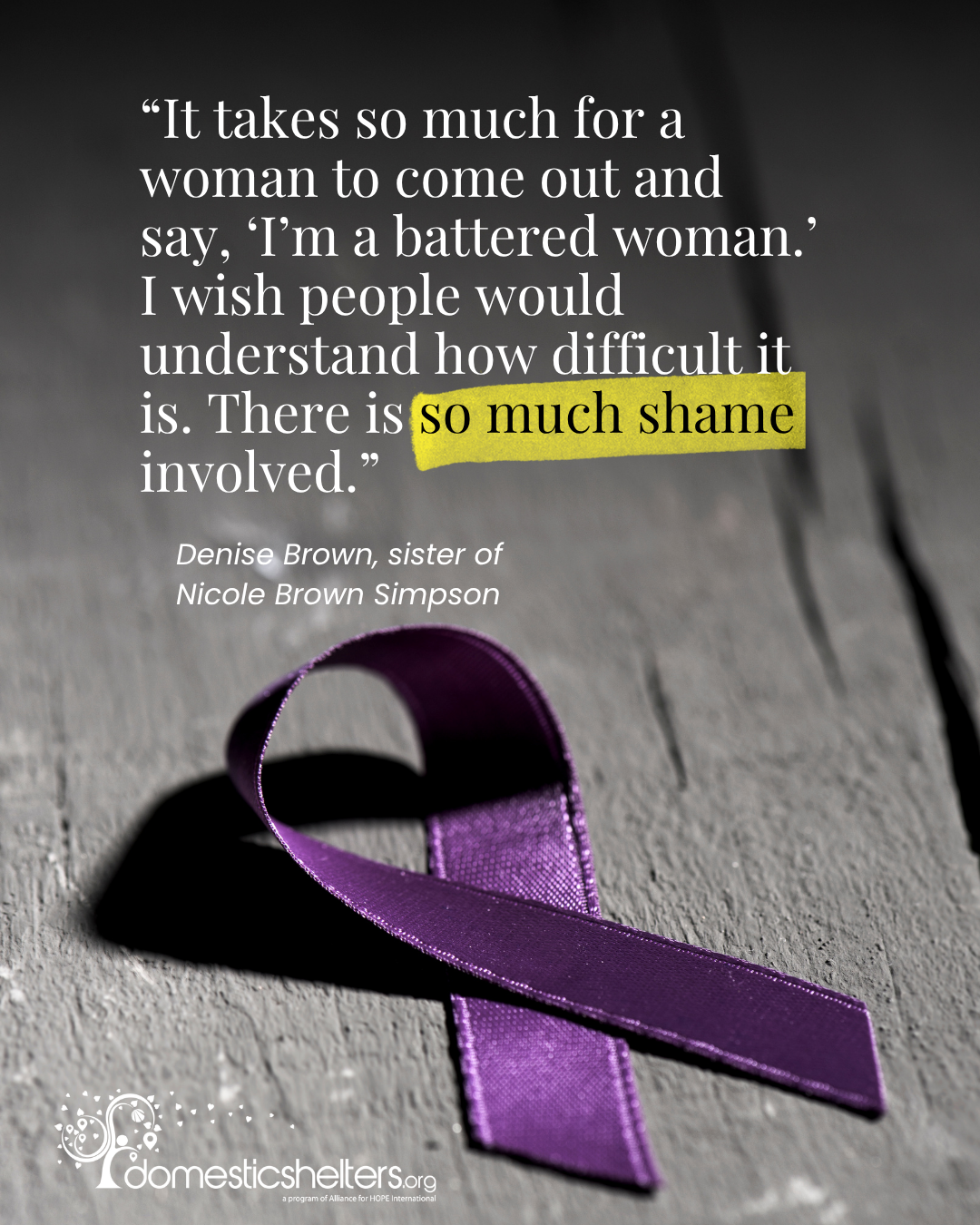
“I don’t think it’s gotten any better,” says Denise forlornly. “Look at Johnny Depp—Amber Heard left the country and now he’s making a fortune. I believe her. It takes so much for a woman to come out and say, ‘I’m a battered woman.’ I wish people would understand how difficult it is. There is so much shame involved. They [survivors] would never come out and say something like this if it wasn’t true. And here you have another celebrity getting away with it.”
For Brown, the lesson she imparts through Nicole’s story is that there is always more to learn. And that speaking up—and speaking out—are the best ways to silence abusers.
Three decades after Nicole’s death, Brown hopes Nicole’s legacy can continue to be awareness, and that abuse doesn’t often look the way we think it does. And through For My Sister Nicole: Love Shouldn’t Hurt—What to Know About Domestic Violence, she hopes others will learn this too.
The book, which draws on Nicole’s journals and Brown’s decades of advocacy, is available now.
Your support gives hope and help to victims of domestic violence every day.

Welcome, this is your discreet connection to help.
You are safe here.
Menstruation is an experience shared by
generations of women across the globe.
Sadly, abuse is another commonly shared experience between women.
Be it physical or psychological, abuse is not OK in any form.
Period.
You are not alone.
Help is just a few clicks away.
Welcome to DomesticShelters.org, a trusted Bright Sky US partner. On DomesticShelters.org, you will find free domestic violence resources such as:
The Bright Sky US website is still open on your browser in a separate tab, so you can return to the Bright Sky US website anytime.


