1. Select a discrete app icon.








notes
Domestic violence often feels like an insurmountable epidemic. The CDC estimates that more than one in three women will be the victim of domestic violence in their lifetime.
Survivors fight for their safety and their children’s safety every day in the court system and too many report not being believed by the judges who determine their future. Some survivors lose their battle to keep children away from critically dangerous abusers, a fate that has resulted in over 1,000 children being murdered between 2008 and 2023, according to a study by the Center for Judicial Excellence. These children were in the middle of their parents’ custody disputes, separation or divorce.
In an unfortunate proportion of cases, survivors try to seek protection from abusive partners and find that the laws will only reach so far—if they don’t have enough evidence of abuse, the conclusion is that it may not have been committed at all.
It can leave the loved ones of these victims feeling helpless, angry and, sometimes, motivated to change things for the next survivor by going straight to the source—lawmakers. The natural progression is to petition local lawmakers, convince them to draft a bill and then wait. And wait. And wait. Sometimes it takes years and sometimes the bill never makes it to the floor for a vote. But for a lucky few, the bill goes all the way to becoming a law, receiving a signature of approval from their mayor, or even better, the President.
For the survivors and families behind the bills highlighted below, the drive for change—and the wait—continues. Their efforts to change the laws are fueled by a determination to ensure that what happened to them or to someone they love doesn't happen to anyone else.
Kyra’s Law passed the New York state assembly in June 2026 and is awaiting Gov. Kathy Hochul’s signature. The bill requires courts to take into consideration any past allegations or evidence of domestic violence or child abuse before making a ruling on who should have custody of a child. It also mandates specialized and consistent training for New York judges on domestic violence, child sexual abuse and the impacts of trauma on children.
For most people, this seems like common sense—ensuring the custodial parent does not have a history of abuse—but survivors like Jacqueline Franchetti know that these protections are not always equally applied.
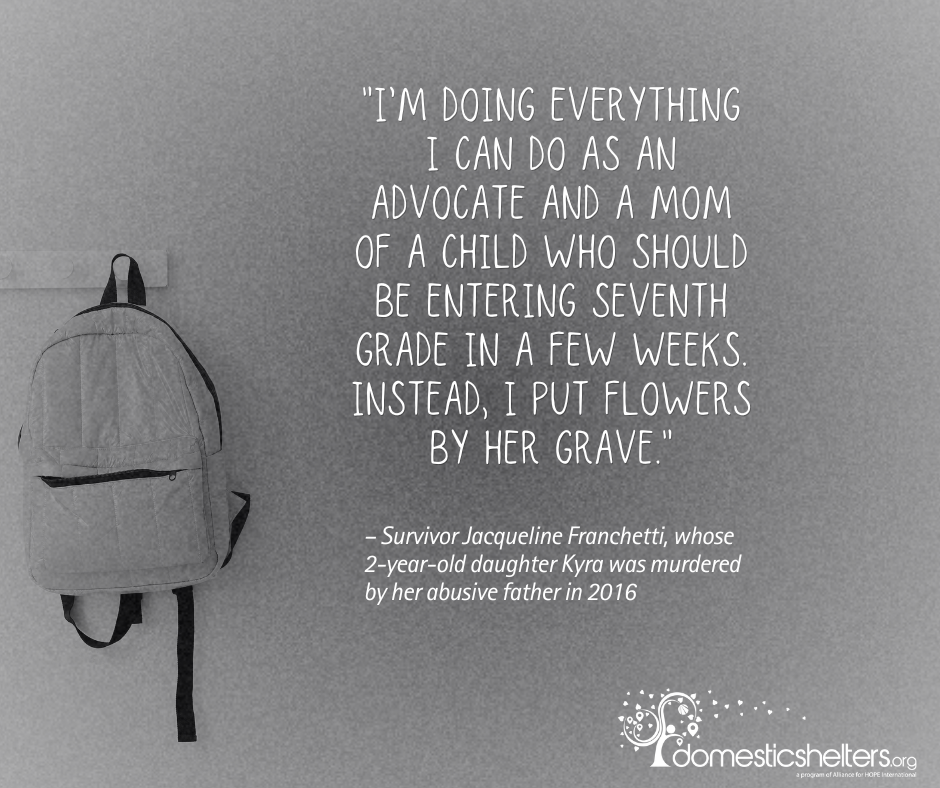
“I’m doing everything I can do as an advocate and a mom of a child who should be entering seventh grade in a few weeks. Instead, I put flowers by her grave,” she says.
For Franchetti, the process to change New York state law took 10 years. She never gave up after 2016 when her 2-year-old daughter, Kyra, was fatally shot by her father before he set his home on fire, killing himself as well. Even with evidence of domestic violence, a family court judge determined it was not a “life or death situation” and allowed Kyra’s father to share custody.
“She was wrong,” says Franchetti, who adds that the judge, who still serves in Nassau County Family Court today, never reached out to her after Kyra’s horrific murder. Six months later, Franchetti started what would become a decade-long journey to change the law.
“This was built step by step, brick by brick. Every single person who has joined our movement I have cold-called or knocked on their door,” says Franchetti. “The first time I had a meeting with an elected official, I couldn’t get through it. I cried the whole time. I knew that I couldn’t do that if I was going to be effective, if I was going to be [Kyra’s] voice.”
Life goes on without Kyra—a blonde-haired little girl with a love for Mickey Mouse and a need for speed on the playground slides. But Franchetti knows a part of her died with her daughter.
“Every day I have a choice,” she says. “I can pull the covers over my head and cry, or I can do this. [Kyra] is someone I miss every single second of every single day. She should be here; she should have been protected; she should have been safe.”
Gov. Hochul has until the end of the year to sign the bill into law. Our calls to her were not returned, but a spokesperson released this statement.
“Governor Hochul’s top priority is to ensure the safety and well-being of children and families, which is why she has made domestic violence prevention and survivor protection a cornerstone of her administration. She has delivered historic funding, strengthened laws, and enacted key systemic reforms. The Governor will continue to support initiatives that increase awareness and broaden protections, and will review any bill that passes both houses of the Legislature.”
There’s a growing movement to exonerate survivors for defending themselves against an abuser, including survivors currently in prison. Last May, Georgia passed the Georgia Survivor Justice Act that allows domestic violence to be taken under consideration when the alleged offender is on trial for harming or killing their partner. It also allows for survivors serving prison terms for harming or killing an abusive partner to be resentenced based on a history of domestic violence.
In January, Nicole Boynton, 44, was the first survivor in Georgia granted release from prison under this new law. She had served 23 years of a life sentence after stabbing her boyfriend when she was just 18 years old. Boynton had suffered years of child abuse before entering a relationship with a man who sexually and physically abused her as well.
According to the ACLU, women who kill their partners will spend an average of 15 years behind bars, while men who kill their female partners serve much shorter sentences, usually between 2 and 5 years.
Currently, only 12 states have laws in place allowing those accused of harming or killing their partner to use domestic violence as a self-defense claim. New York was the pioneer of this type of law, passing a Survivors Justice Act in 2019, with Illinois, Oklahoma and then Georgia following suit. Connecticut, Massachusetts and New Jersey are all working to pass similar laws.
If passed, this bill would increase the compensation afforded to crime victims and domestic violence survivors. This compensation is for victims who are left with medical bills, lost wages, property damage, therapy costs and so on.
Additional bills awaiting passage by the New York State Assembly would include prioritizing domestic violence victims who are awaiting public housing as well as a bill to require that police conduct a lethality assessment at every domestic violence call. The assessment (a series of questions about the history of abuse by a partner) determines what level of danger the victim is in and how close the abusive partner may be to committing homicide. This information can not only help victims understand the seriousness of their situation but also allow for domestic violence shelters to prioritize emergency shelter for the individual.
See “Money Means Freedom” to access an easy-to-use tool called the Compensation Compass that can help survivors assess what compensation they may be owed.
If passed, Bill 702 would criminalize coercive control as a form of domestic violence. Coercive control is a pattern of abusive behavior that strips away a survivor’s sense of self, creating dependence on an abusive partner. Abusers who use coercive control tend to isolate survivors; limit their financial independence; stalk their partner; abuse them verbally (e.g., name-calling, humiliation); gaslight and be physically violent, among other tactics.
This bill would also expand the protections to current or former dating partners (not just spouses and former spouses). Additionally, it would allow domestic violence, stalking and harassment to be taken under consideration in family court when assessing custody decisions.
In an effort to close legal gaps in responses to domestic violence crimes, the Protecting Victims Act would give D.C. courts more leeway to keep abusers away from their partners. In part, the act calls for:
"I am stunned to come here from New York and find out that if you assault a child, or assault a spouse or a partner in front of a child, there is no separate crime," U.S. Attorney Jeanine Pirro told local media. "We've got to make that a crime because there is no question that the consequences are long term.” Pirro is working with D.C. Mayor Muriel Bowser to push the legislation forward.
This past June, Bill C-16, known as the Protecting Victims Act, received Royal Assent (aka, was signed into law for those not familiar), making vitally important changes to Canada’s Criminal Code. Among them:
Review the complete list of amendments to the criminal code here.
Even though Gov. Bill Lee signed SB 1241 into law in May of 2025, it definitely deserves accolades. The new law recognizes children who witness domestic violence by a parent or toward another child in the home as victims of child abuse. Teachers, who are mandated reporters of child abuse, are now required to report if a student discloses domestic violence by a parent or caregiver.
Advocates and other domestic violence experts have long warned of the effects on children of witnessing abuse. This type of trauma plays into one’s ACE, or Adverse Childhood Experiences, score. The more traumatic experiences one endures in childhood, the higher likelihood of adverse physical and mental health challenges later in life.
A separate clause within the law went into effect at the end of January 2026 requiring that the Tennessee Department of Children’s Services submit semiannual reports to the legislature documenting the number of children removed from their homes and placed in foster homes due to domestic violence.
In case you missed it, a 2025 executive order issued by President Trump, called “Protecting Second Amendment Rights” ordered that the Attorney General assess enforcement policies and licensing regulations that could stand in the way of gun ownership under federal and state law.
Soon after, the DOJ proposed that those prohibited from owning guns, including felons, would be able to apply for an individualized review by the Department. It expects up to one million applicants once the system is approved, but in the meantime, gun bans for 22 individuals have already been reversed.
The review outlines an disqualifier for those “under a court-ordered restraining order for harassment, stalking or threatening an intimate partner or intimate partner’s child.” However, not all survivors of intimate partner violence petition for or are granted an order of protection for varied reasons. Despite this, their abusive partner may have still been convicted of domestic assault or child abuse.
Those convicted of a felony for stalking or domestic violence, among other crimes, within the last decade, may also be disqualified. But as many advocates will point out, very few cases of the already undrereported crime of domestic violence will ever result in jail time, much less a felony conviction.
Additionally, there is a disclaimer for each disqualifier that states, “absent extraordinary circumstances,” which leaves the validity of the so-called disqualifier up to the discretion of those at the Department of Justice.
Among those who have since been reauthorized to own guns include actor Mel Gibson, who was accused in 2010 of punching his then-girlfriend Oksana Grigorieva in the face and breaking her teeth while she was holding their 1-year-old daughter. He pled guilty and avoided jail time, paying $570 and receiving a year of domestic violence counseling instead.
The Democratic Women’s Caucus responded to this order last year with a letter to then-Attorney General Pam Bondi asking that the DOJ require “multiple, non-familial witness statements and the examination of felony and domestic violence misdemeanor indictments,” before reissuing gun rights.
“The restoration of firearm rights should not come at the expense of a woman’s right to live free
of violence,” they write.
According to Everytown for Gun Safety, at least 70 women are shot and killed by their abusive partners every month. Additionally, domestic abuse survivors are 500 percent more likely to be killed by an abuser when there is access to a firearm.
Laws can change, but only when people stand up to champion them. Consider contacting your lawmakers and voicing your support for laws that can keep survivors safe. See “How to Call Your Lawmakers” to learn how. Ready to change the law yourself? Read “Five Awake: Women Who Changed Louisiana’s Law,” to learn how a group of friends rallied to change a law after one of their own was murdered by her husband.
Your support gives hope and help to victims of domestic violence every day.

Welcome, this is your discreet connection to help.
You are safe here.
Menstruation is an experience shared by
generations of women across the globe.
Sadly, abuse is another commonly shared experience between women.
Be it physical or psychological, abuse is not OK in any form.
Period.
You are not alone.
Help is just a few clicks away.
Welcome to DomesticShelters.org, a trusted Bright Sky US partner. On DomesticShelters.org, you will find free domestic violence resources such as:
The Bright Sky US website is still open on your browser in a separate tab, so you can return to the Bright Sky US website anytime.


