1. Select a discrete app icon.








notes
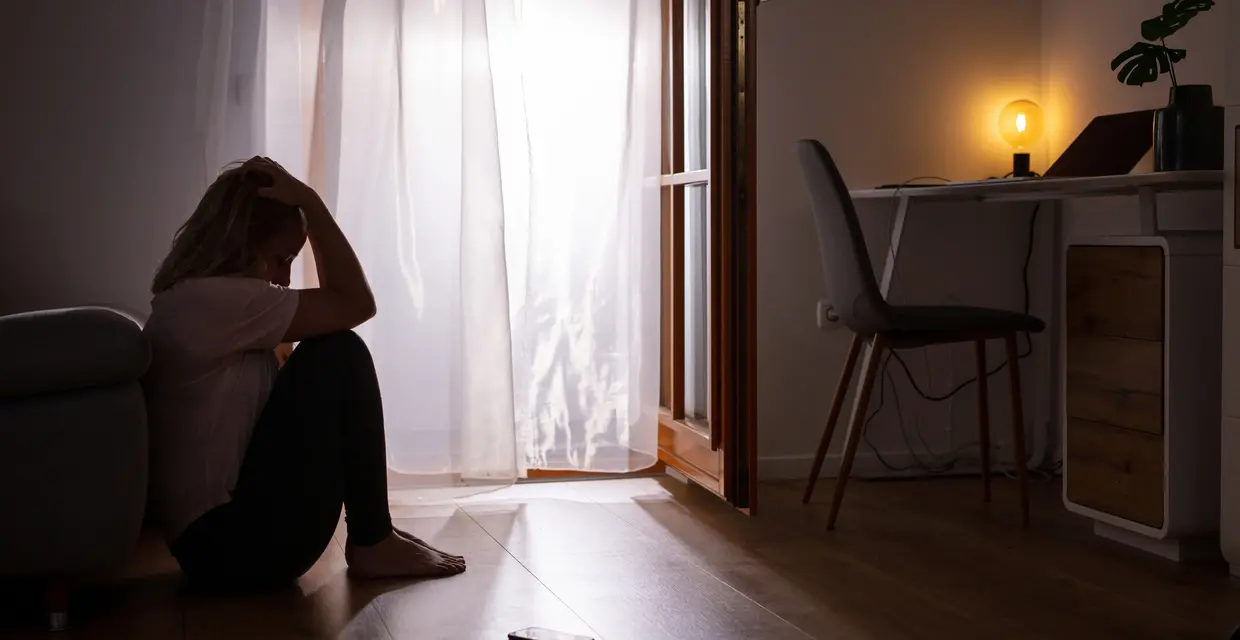
Someone who cares about you sent you this article. Not because they’re trying to control you. Not because they think you’re incapable of making your own decisions. But because they’re worried.
As a journalist who covers intimate partner violence, I often hear from family members and friends who feel helpless. Maybe they’ve tried to explain what they’re seeing. Maybe they’ve tried to say the right thing. Maybe their words don’t quite land.
So they’ve sent a link instead.
Just stay for a few minutes.
Here’s the only thing I want you to consider: someone who loves you is seeing something that makes them uneasy. It might not match how things feel to you. That’s okay. But it might be worth wondering why their perspective feels so different.
No, they’re not in your relationship or your home. They don’t see everything. They probably don’t know the half of it.
But they do know you.
They know your laugh. Your spirit. The way you used to show up in the world. And something feels different to them.
They care about you. And at the most basic level, they want you to feel safe, steady and okay.
When I talk to survivors, many of them tell me the same thing: “If someone had described it to me back then, I would have said, ‘that’s not us.’”
The early moments in relationships where one partner is controlling rarely look like danger. They look like intensity. Passion. Protection. Jealousy that feels flattering and arguments that end in big apologies.
Here are some of the patterns they described—not as proof of anything, just as things they wish they’d understood sooner:
These patterns, and more, are illustrated on a diagram called the Power and Control Wheel, a tool that helps some survivors see their situation outlined more clearly. The center of the wheel is power and control—the main goal of abusive partners—and surrounding it are eight spokes outlining the different tactics abusers use to gain that control.
Even if one of these tactics feels familiar, it can indicate that a partner is using an abusive tactic to control you. That can be an uncomfortable feeling. You don’t necessarily have to do anything just yet. Noticing is enough for now.
You might be telling yourself that the person who’s worried about you doesn’t really understand what you’re going through—so how could they possibly give you advice? That’s a common feeling. Sometimes, though, it helps to hear from people who have been in a similar place.
We asked survivors in our online support group to share something a friend or loved one said that helped them finally see their partner more clearly—not as someone who was simply misunderstood or deserving of one more chance, but as someone whose behavior was about control.
Here are some of the words that helped survivors begin to see their situation differently. We’ve changed all of the survivors’ names for safety.
“I had a good friend. We rarely actually talked on the phone. We only texted at this time. I told them that I had just been punched in the face while I was holding my baby and then the phone rang. They said they never wanted to hear anything like that from me ever again and for me to go to my mom’s house.” – Nicole
“I remember my daughter at two2 years old saying, ‘Mommy no cry today, okay?’ And that was eye opening for me. That my kids could see the pain I was in daily and that they wanted me to be happy. I thought I was keeping it from them. And at that moment I didn’t want my daughter to think that was normal or OK for a relationship … My next thought was ‘How?’ But I figured it out, eventually.” – Maxine
“His neighbor told me that [her partner] fully intended to kill me in front of my daughter.” - Gwen
“My therapist told me, ‘You know that fully qualifies as abuse and rape right?’ Then I was talking with …an ex-FBI agent. He said, ‘You need to get out now. This is a murder/suicide waiting to happen. I’ve seen it too many times before.’” – Alicia
For survivor Kaylynn, it wasn’t words from someone outside her relationship that struck a chord. It was something her abusive partner told her instead.
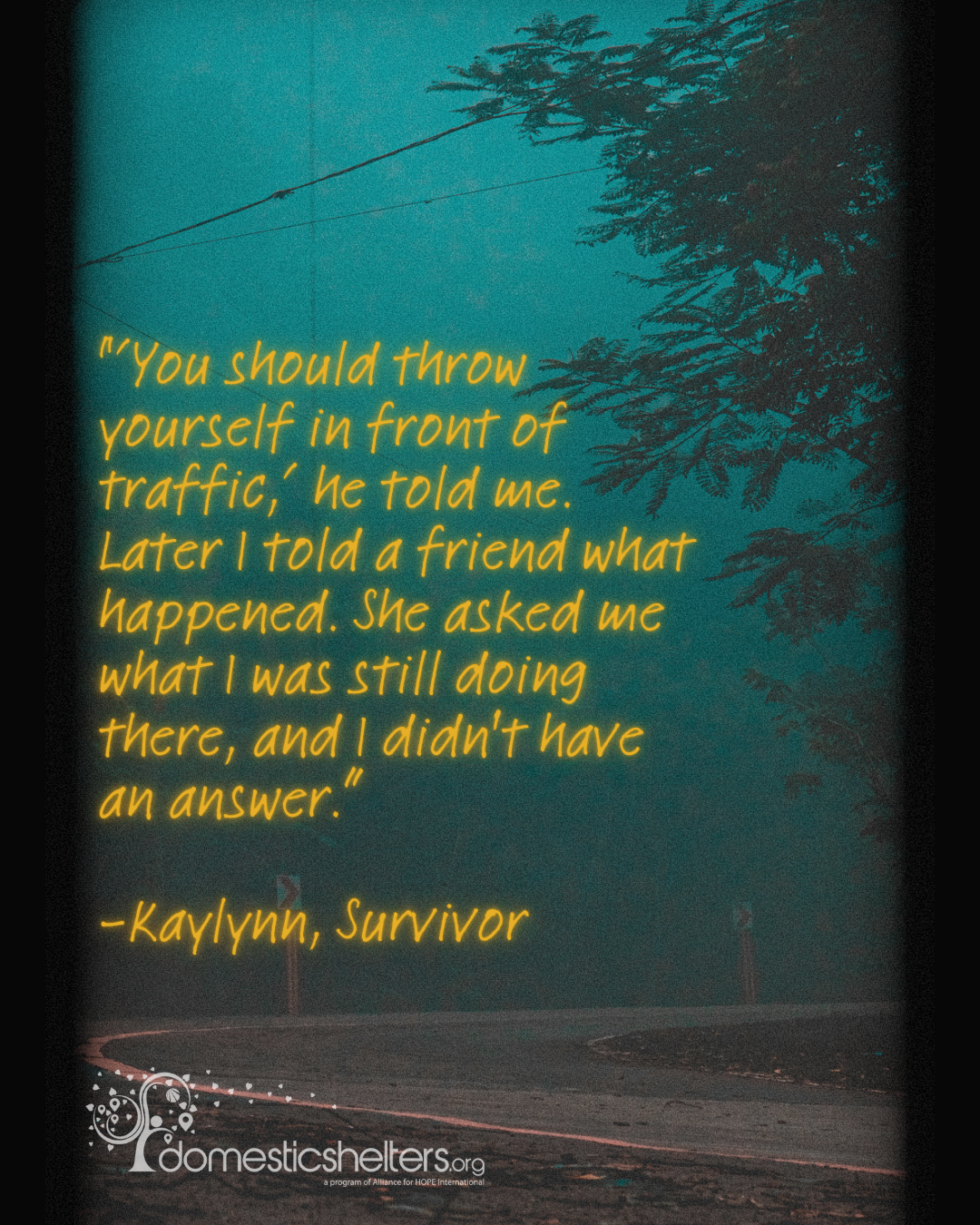
"’You should throw yourself in front of traffic,’ he told me. Later I told a friend what happened. She asked me what I was still doing there, and I didn't have an answer.”
At this point, you may be thinking, “This isn’t my situation at all.”
Or you may be thinking the opposite: “Some of this sounds familiar.”
Either is OK. You might want to take this moment to explore a few more articles on DomesticShelters.org that speak to your situation more specifically. Or you may want to peruse a few more Survivor Stories to hear from other individuals about when they realized their partner was not who they believed them to be, and what happened next.
If you are starting to see that your relationship isn’t healthy or safe, you don’t need to leave immediately. For a lot of survivors (and that’s what anyone who endures abuse is), leaving an abusive partner is a long process and not one made impulsively. Only you know when it’s safest to leave and how to go about doing that.
Bottom line: You deserve to feel safe in your own life. You deserve relationships where you don’t have to shrink yourself, explain away someone else’s cruelty or constantly wonder if something is wrong.
And if someone in your life sent you this article, it’s because they care deeply about you. They may not have the perfect words. They may not understand every detail of your situation. But their concern comes from a place of love.
If you ever want to talk to someone who understands these patterns and won’t judge you, confidential help is available by calling a domestic violence shelter and speaking to an advocate. Advocates can help you think through options, make a safety plan or simply listen. You don’t have to be ready to leave to reach out.
For now, just remember this: the uneasy feeling you might be carrying isn’t something you have to ignore.
You deserve to be safe.
Your support gives hope and help to victims of domestic violence every day.

Welcome, this is your discreet connection to help.
You are safe here.
Menstruation is an experience shared by
generations of women across the globe.
Sadly, abuse is another commonly shared experience between women.
Be it physical or psychological, abuse is not OK in any form.
Period.
You are not alone.
Help is just a few clicks away.
Welcome to DomesticShelters.org, a trusted Bright Sky US partner. On DomesticShelters.org, you will find free domestic violence resources such as:
The Bright Sky US website is still open on your browser in a separate tab, so you can return to the Bright Sky US website anytime.


