1. Select a discrete app icon.








notes

This piece was originally published in 2021. It was updated in 2026.
Emotional or mental abuse is when an abusive partner deliberately manipulates a survivor’s feelings to make them feel degraded, crazy and ashamed.
Why would a partner do this? As with all types of intimate partner abuse or domestic violence, the goal is to control the other person. A survivor of emotional abuse may find themselves deep into a relationship before realizing that every choice they make is carefully orchestrated by their partner—from what the survivor wears to who they see and where they go.
Below, we’ll help you identify the signs of emotional abuse, give you some examples of what it looks like as well as ideas for how you can disentangle yourself from an abuser using this tactic.
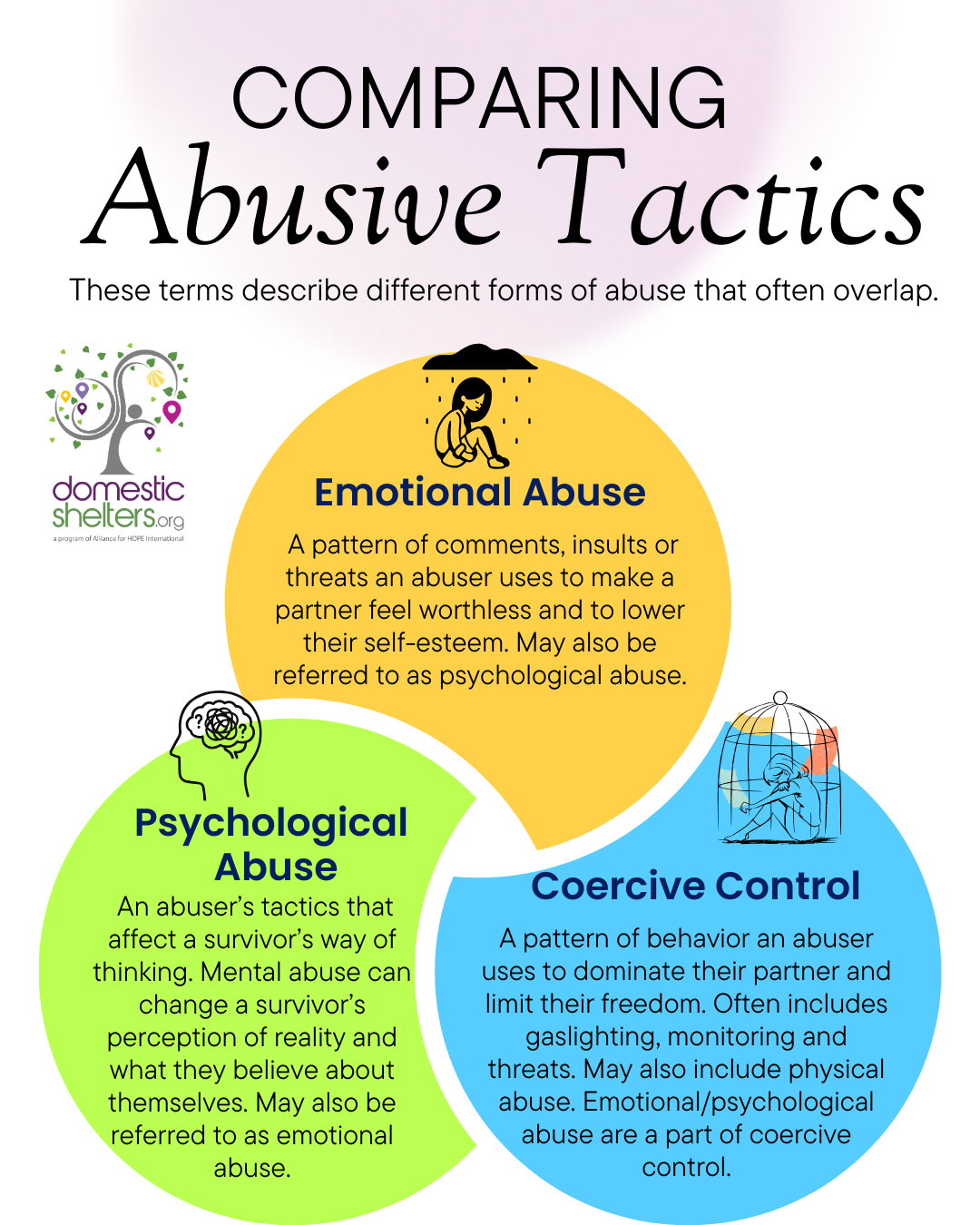
Emotional abuse (sometimes referred to as mental abuse or psychological abuse) is characterized by a pattern of making a partner feel worthless to lower their self-esteem. Over time, that partner may feel dependent on the abuser for scraps of validation, a type of gaslighting that the abuser uses to make the survivor believe only the abuser could love someone as insignificant as the survivor.
Emotional abuse can often start subtly, with the abuser using the excuse of caring so much about their partner that they just want what’s best for them. Eventually, the survivor realizes they are under someone else’s control, and that caring is actually not kindness at all, but rather abuse.
Releasing yourself from that control is not as simple as giving a break-up speech and walking away. Even if the abuser has never been physically violent, the survivor may feel an innate threat to their safety and well-being, as well as the safety of others in their home, such as their children or pets.
Signs of emotional abuse include:
Yes, emotional abuse is a form of domestic violence. At its core, domestic violence is a pattern of aggressive power and control exercised by one person over another—most often an intimate partner. However, it can also be perpetrated by a parent against a child (or vice versa) or by another family member, such as a sibling, uncle, or grandparent. Emotional abuse can even occur against a roommate in a shared living situation.
Because it’s often subtle, emotional abuse can be difficult for victims to recognize and even harder to prove, allowing abusers to get away with it for an absurd amount of time. It’s also all that much easier to shift blame onto the survivor, branding them as the ‘crazy’ one, the ‘oversensitive’ one or the ‘dramatic’ one. This is called gaslighting.
Together, these nonphysical forms of abuse fall under the umbrella of coercive control, a pattern of behaviors (e.g., isolation, intimidation, manipulation, stalking) abusers use to dominate their partners and limit their freedom.
And like most forms of nonphysical abuse—verbal, financial and spiritual being other types—those who use emotional abuse often escalate over time to other forms of control, mainly physical forms. Soon, degrading words become threats of harm, and then actual harm. Tracking a partner on their phone escalates into showing up at a partner’s apartment, banging on the door and demanding to be let in.
Mental, emotional and psychological abuse are overlapping terms that describe similar behavior. All three are types of abuse that aim to destroy a partner’s self-worth, independence and confidence so that they become dependent on the abuser. Separately, they may focus more on the following aspects:
Regardless of how a survivor identifies it, this type of constant control through manipulation and put-downs is abuse.
The examples below are fictional and meant to show how emotional abuse can present. It’s important to note that emotional abuse occurs across all genders and relationships and can be perpetrated by any gender against any gender.
No, emotional abuse can also prey on a survivor’s need for love and affection. An abuser may build up a survivor’s self-esteem through love-bombing, only to then subtly tear it back down and convince the survivor that the abuser is the only one who will ever love them.
Love-bombing can also look like an abuser who starts off as a near-perfect partner, showering an individual in attention and adoration, resulting in that survivor falling in love hard with this seemingly ideal partner. Then, the abuser begins to control, intimidate or degrade the survivor.
You can learn more about about this form of emotional abuse by reading:
If you think your partner may be using emotional abuse to control you, ask yourself the following questions.
Does your partner….
… put you down, embarrass or shame you (publicly or in private)?
… call you names?
… accuse you of being unfaithful without basis?
… punish you?
… ignore you?
… demand to know where you are every minute?
… treat you as inferior?
… not allow you to make decisions?
… rarely validate your opinions?
… threaten you?
… tell you that you’re crazy?
… belittle your accomplishments, aspirations or plans?
… forbid you from talking to or seeing your friends, family or coworkers?
… keep you from sleeping or make it difficult for you to sleep?
… act possessive or jealous?
… cheat on you and then blame you for his or her behavior?
… tell you that you will never find anyone better or that no one will ever love you?
… repeatedly point out your mistakes?
… attempt to control what you wear?
…control how you spend money?
… threaten to hurt or punish you, your children, your family or your pets?
Emotional abuse can creep in subtly, and abusers rely on this. By calling you ‘oversensitive’ while doing any of the behaviors below, they can keep you doubting yourself at all times.
If an abuser regularly insults you, humiliates you or makes you feel bad about yourself, this is belittling. It’s a form of mental abuse that relies on an abuser tearing down your self-esteem in order to create a sense of dependence on the partner for self-worth.
You may have accomplished something great at school or your job and your abusive partner completely ignored it. Or they might reply flippantly, ”So what? Anyone could do that.”
It might look like a partner who brings up your past mistakes just to make you feel bad about yourself. It also looks like a partner who blames you for their abusive choices and says things like, ”If you just didn’t make me so mad, I wouldn't act like this.”
If an abuser is making you doubt your reality, this could be gaslighting.
Let’s say an abuser verbally berates you in front of your friends at a party. Later on, when you bring it up, the abuser says, ”That didn’t happen. Everyone knew it was a joke. You even laughed. You thought it was hilarious.” But your gut feeling is that this isn’t right.
If an abuser repeatedly makes you doubt your sense of reality and your own memories, they are likely gaslighting you.
If an abuser is attempting to manipulate how you think, this could be brainwashing. It looks like they are blocking you from making decisions for yourself or Dictating to you what the truth is (e.g. “You don’t want to go out with your friends anymore,” “You don’t want to take that job,” “You’re not a very smart person,”). It can also include exhausting you physically through forced labor or sleep deprivation, which impairs your decision-making ability.
If an abusive partner has a habit of shutting you out for an extended period of time after an argument, or for no reason at all, this is a tactic called the silent treatment. It can leave a survivor feeling despondent and desperate for a partner to acknowledge them.
The silent treatment can feel threatening, as though you’re walking on eggshells, unsure if your abusive partner will explode in anger at any second. It can take away any feeling of joy or safety within a relationship and make you feel alone.
Naming emotional abuse is painful—and it often comes with an impossible-feeling decision. You can stay and hope the behavior changes, even though it usually doesn’t. Or you can choose to leave before the harm deepens. You deserve safety and dignity. We hope you choose the path that protects you.
To escape an abuser using emotional abuse, it’s helpful to:
It's important to make sure you don’t underestimate what an abuser is capable of, even if they’ve never resorted to physical violence before. An emotional abuser will rely on tactics like gaslighting to lure you back, saying things like, “But that never happened,” or “You’re remembering it wrong.”
Don’t fall for it.
The effects of emotional abuse can be just as devastating as physical abuse, even without visible wounds. Over time, emotional abuse can erode a survivor’s self-esteem and cause long-term stress, fear, anxiety, depression, PTSD (post-traumatic stress disorder) and an overall inability to trust. A survivor may suffer from insomnia, chronic headaches and even suicidal thoughts.
Healing from emotional abuse is possible. You may want to consider the following steps:
Remember, if you had to shrink, go quiet, or become a ‘grey rock’ to survive, the problem was never you. Healing is about becoming fully yourself again—at your own pace. Every day away from someone who made you feel unworthy brings you one step closer to reclaiming your life and your sense of self.
Still not sure if what you’re experiencing is abuse? Ask Hope Chat by clicking on the chat box in the lower right-hand side of your screen. Hope Chat is trained to understand abuse and can help you better understand how what you just read applies to your specific circumstances.
Your support gives hope and help to victims of domestic violence every day.

Welcome, this is your discreet connection to help.
You are safe here.
Menstruation is an experience shared by
generations of women across the globe.
Sadly, abuse is another commonly shared experience between women.
Be it physical or psychological, abuse is not OK in any form.
Period.
You are not alone.
Help is just a few clicks away.
Welcome to DomesticShelters.org, a trusted Bright Sky US partner. On DomesticShelters.org, you will find free domestic violence resources such as:
The Bright Sky US website is still open on your browser in a separate tab, so you can return to the Bright Sky US website anytime.


