1. Select a discrete app icon.








notes

A staggering 1.5 million high school students are abused by a dating partner every year. Although this topic isn’t necessarily on the radar for young people, it’s still a cause of anxiety for many parents and teachers who witness excited teens venturing into the dating world.
This concern has fueled an increasingly common—and sometimes polarizing—question: Should schools play a larger role in teaching about consent? And if they did, would it reduce the risk for dating violence among their students?
Consent is an intentional, uncoerced agreement that you are allowing something to happen or that you’re willing to partake in an activity. Consent is specifically agreeing to one specific thing with the clear understanding that your consent doesn’t expand beyond that, and that you can change your mind during the activity. Consent is also saying a clear “yes.” Consent is not given when the person simply doesn’t say “no.”
When it comes to any kind of intimacy among partners, consent should always be asked for. It allows for a partner to create boundaries around what they are comfortable and not comfortable doing. Young people may not be aware that they are able to set boundaries when it comes to dating partners—especially young women who are often conditioned by society to be agreeable and polite.
Saying “no” can seem intimidating. What if the other person feels offended? What if they make fun of me? What if they get mad? Teaching young people that setting healthy boundaries can make them feel safe in a relationship and in control of their own bodies. Likewise, the absence of consent and the crossing of boundaries without permission is a red flag and possibly a sign of a controlling or abusive partner.
Talking to kids about consent can start as early as toddlerdom. Jayneen Sanders is an early education teacher in Australia, a mom and the author of Let’s Talk About Body Boundaries, Consent & Respect.
“When they are little babies we can’t ask their permission, but we can respect the child by explaining what we are doing, e.g. ‘I’m just going to change your nappy so you can stay clean.’ As they get older, we can say things such as, ‘Can you please open your mouth so I can help you clean your teeth?’” says Sanders in “Turns Out, 3 Isn’t Too Early to Talk Boundaries.” As a result of this parenting technique, she says that her daughters, now in their 20s, grew up to be assertive teens, a trait that carried over into adulthood.
Just as important as it is to give consent, young people should understand what asking for consent looks like. For young children, this means asking for permission before borrowing a toy or giving a friend a hug. In teen and young adult years (when dating relationships might begin), asking for consent can sound like:
When it comes to intimacy, asking for consent might sound more like:
It’s not uncommon for TV shows and “romance” movies to skip consent altogether, sending the message that aggressive or boundary-crossing behavior can be romantic. Without a contrary lesson in consent, young people may absorb the idea that persistence and boundary-pushing are what true romance looks like.
When asked, most parents told us that consent was an issue readily talked about in kindergarten and other early grade levels, usually centered on the importance of sharing. But when it comes to older ages, specifically in the area of consent around dating relationships, schools seem to step out of the conversation.
“My 6-year-old attends a school here locally and in kindergarten there was a lot about consent. To me, it wasn’t a big deal because at home we tell our children to ask before they touch anything and …if you don’t want to be hugged the answer is no, point blank. Yes, kinder covers consent. But no, it’s nothing sexual or some agenda-pushing nonsense in my experience,” one anonymous parent said.
For some parents, the issue becomes more contentious when consent education moves beyond personal boundaries and into sexual or dating relationships.
“I agree that this is mainly a parenting issue,” says another parent who requested her name be withheld. “However, many are not doing their part…once kiddos are in junior high and high school, I certainly would hope they know what consent is and parents have continued addressing this. Upper grades should cover this in sex-ed if it’s still being taught.”
Traditionally, sex education has focused on anatomy, pregnancy prevention and sexually transmitted diseases. Lessons about healthy relationships, communication, consent and dating abuse red flags are a more recent addition, and whether they belong in the classroom remains a subject of debate.
Schools are not federally mandated to include sexual education—or even health education—in their curriculum. These decisions are made at the state level. As of 2025, 42 states required sex-ed in at least one content area between grades K-12. Thirty-four states allowed parents to opt-out their children. And according to Planned Parenthood, fewer than half of the states require the information schools share to be medically accurate.
Not everyone believes schools should be responsible for those conversations. One mother who talked to us for this piece but requested anonymity said parents, not teachers, should be covering the topic of consent, even while acknowledging that she knows not every parent will deem this conversation important.
“I personally think people expect schools to take on too much of the burden of a lot of topics that should be primarily taught at home. I acknowledge not all kids are getting taught at home, but I also work in education and what is expected is far beyond what can ever possibly be delivered. One of the many reasons the school system is failing.”
Another anonymous parent, the mom of a middle schooler, says her daughter had a one-hour class in fifth grade about anatomy and periods. Her daughter told her the teacher briefly touched on boundaries and consent, but since then, “her schools haven’t talked about it at all, and she’s going into the eighth grade now.”
Holly, who requested her last name be withheld, is an elementary school teacher in Phoenix, Ariz. She says she’s concerned that consent is not included in any schools’ curriculum where she’s taught.
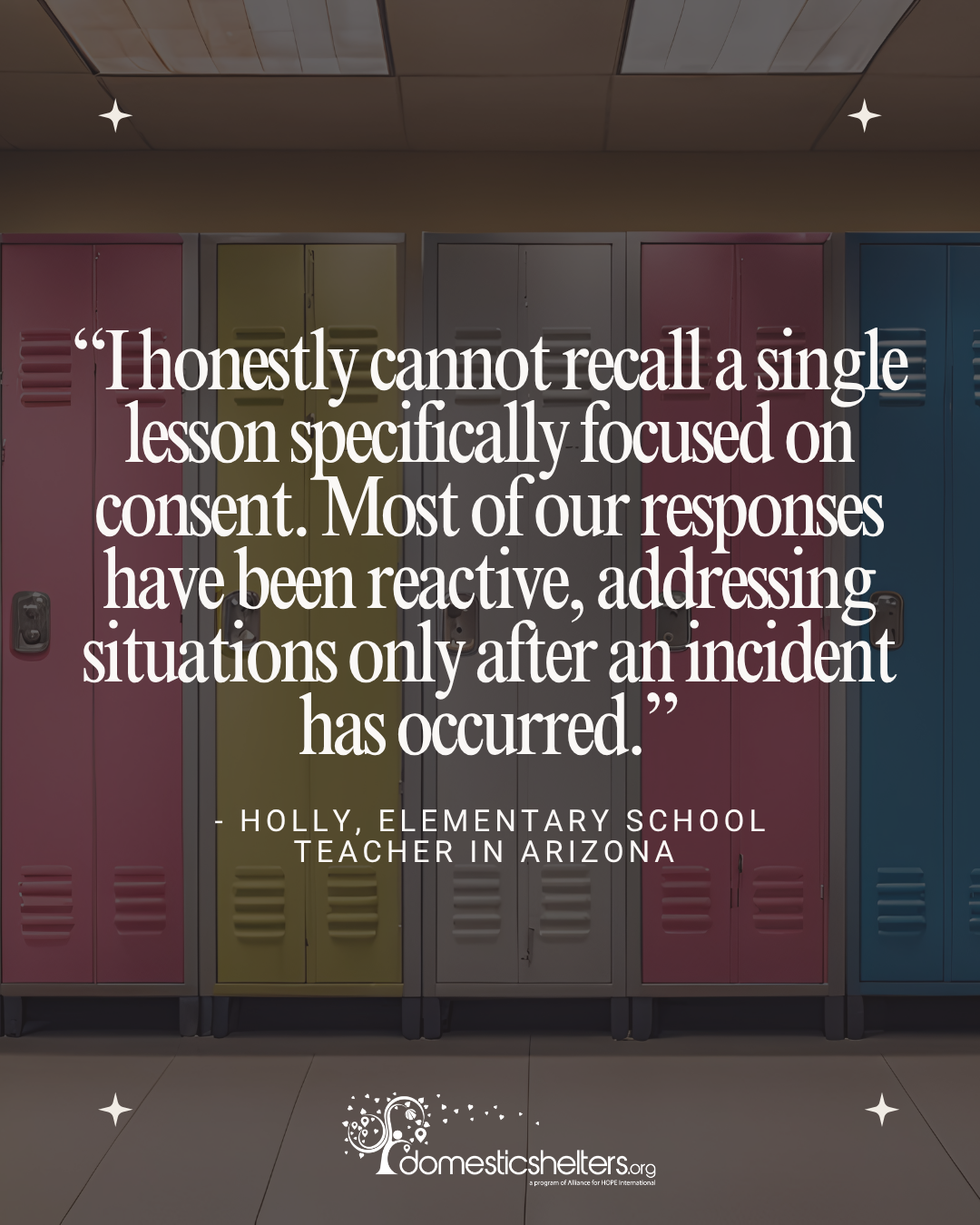
“As teachers, we are trained to recognize the signs of abuse or harm and to report concerns, but we are not often taught how to be proactive in helping children understand consent before problems arise. I’ve taught in multiple schools throughout the greater Phoenix area, and every school has emphasized respect and kindness as core values. Yet … I honestly cannot recall a single lesson specifically focused on consent. Most of our responses have been reactive, addressing situations only after an incident has occurred.”
In a Princeton University study, researchers talked to over 1,600 college-bound individuals between ages 18 and 24 and found that those who had received pre-college education on sexual refusal (i.e., how to say no to sex), were less likely to be victims of sexual assault in college. Ten percent fewer female students who had this education reported being assaulted in college. The study findings also concluded that other types of sexual education didn’t affect the risk of sexual assault.
“However, having received most other features of school-based sex education before college was not associated with higher or lower risk of [sexual assault] in college; these included instruction about methods of birth control, sexually transmitted diseases and how to prevent HIV/AIDS. Nor was abstinence-only instruction associated with risk of [sexual assault],” read the study’s findings.
One student included in the study said her pre-college education around sex was lacking at best.
“… once or twice a year, we would have a nurse or somebody who would come and talk to us about sex and puberty. But it was very much from a medical perspective, ‘This is what your period is; this is what birth control is. This is what reproduction looks like.’ But we didn’t learn about sexual violence or things like that.”
Whether the lessons happen at home, at school or both, young people need not only an understanding of how to say no, but why it’s their right to do so. They need to know how to set their own boundaries, ask about someone else’s and understand that a healthy relationship includes both. But if parents aren’t comfortable taking on this topic at home, and schools are torn on whether or not they should bring it up, where will kids learn?
“As awareness has grown around the many challenges children face, school districts have done a better job advocating for issues such as bullying, mental health and abuse prevention,” says Holly. “However, conversations about consent are still not consistently part of our everyday teaching. If we begin teaching these concepts early and provide children with a common language around consent, we could prevent many difficult situations before they happen.”
To start down the road of talking to your kids about dating violence—including both the red and green flags of dating partners—read “Teaching Teens About Dating Violence.” Or, start with these “5 YA Novels About Dating Violence for Teens and Adults.” Reading a book together can start an eye-opening discussion.
And to learn more about how some popular online influencers are specifically targeting young men who promote misogyny and give the OK to mistreat a female partner, read, “What Is the Manosphere?”
Your support gives hope and help to victims of domestic violence every day.

Welcome, this is your discreet connection to help.
You are safe here.
Menstruation is an experience shared by
generations of women across the globe.
Sadly, abuse is another commonly shared experience between women.
Be it physical or psychological, abuse is not OK in any form.
Period.
You are not alone.
Help is just a few clicks away.
Welcome to DomesticShelters.org, a trusted Bright Sky US partner. On DomesticShelters.org, you will find free domestic violence resources such as:
The Bright Sky US website is still open on your browser in a separate tab, so you can return to the Bright Sky US website anytime.


