1. Select a discrete app icon.








notes

Domestic violence doesn’t just affect people. A lot of times, abusers are violent towards pets or use threats against pets to intimidate survivors and exert power and control. Sometimes, animal abuse comes first. Animal abuse can be a warning sign that the violence will extend to people. It’s important for those experiencing abuse and the care professionals (for humans and animals) around them to understand the connection. When veterinarians recognize and report animal abuse, they can play a crucial role in preventing domestic violence before it escalates.
Surprisingly, not all states require veterinarians to report animal abuse. Twenty-four states require state-licensed veterinarians (and sometimes vet techs) to report suspected animal abuse, according to the Michigan State University College of Law report from 2025. Other states only require mandatory reporting of aggravated cruelty or suspected dogfighting. Pennsylvania is unique in that it requires reporting of cruelty by other veterinarians.
Some states have voluntary or permissive reporting. Voluntary or permissive reporting means veterinarians are allowed to break patient confidentiality and report suspected animal abuse, but they aren’t required to do so. Six states (Iowa, Delaware, New Jersey, South Carolina, South Dakota and Wyoming) have no laws or regulations that require reporting.
In states that allow or mandate reporting, it can be tricky for veterinarians to know for sure if what they’re seeing is, in fact, abuse.
Veterinarians take an oath that’s similar to the Hippocratic Oath doctors take.
“That requires us ethically and morally to protect animals, be a trusted advisor and be an advocate for animals. So there is a responsibility … that if there is suspicion of animal abuse, whether it's direct or indirect, to report it,” says veterinarian and RedRover board member Amanda Landis-Hanna.
Even though veterinarians focus on caring for animals, they take a professional oath where they commit to protecting public health as a whole.
Reporting abuse can be crucial for getting help for both animals and people. “When we see animals come in with suspected abuse, it's important for veterinarians to report it,” Landis-Hanna says. “It may be the most visible sign of issues within the household.”
Phil Arkow is the president and secretary of the National LINK Coalition, the global resource center on the link between animal abuse and human violence. Arkow would like to see the veterinary profession become a safe space where people can report any type of abuse. The majority of vets and vet technicians are women, as are most clients bringing their pets in for care. “There’s a high likelihood that there’s domestic violence swirling around any vet office,” he says.
Learn more about how to build pet-inclusive support for domestic violence survivors with Alliance for HOPE International's free Pets and Family Justice Centers Toolkit.
Access ToolkitArkow says, “Our motto is very simple: When animals are abused, people are at risk. When people are abused, animals are at risk. Animal abuse is one of four forms of family violence. It is linked with child abuse, domestic violence and elder abuse.”
Landis-Hanna shared ways animal abuse and domestic violence may play out. “In some cases, one precedes the other. It can look like direct forced abuse, where an instigator forces a victim to apply abuse to a companion animal. There can also be abuse by the perpetrator to the animal directly, while the victim is forced to watch.”
There is often emotional abuse, even without physical abuse. “The abuser can threaten harm or lack of safety to a pet without actually applying it. The abuser can say, ‘Watch what I am doing to your beloved pet. I'm going to do this to you next.’ If there is any trauma threatened or perpetrated against the animal, the human should always be on high alert that there is a very small stepping stone between animal abuse and human abuse,” she says.
Arkow notes that many of the concerns about reporting animal abuse are the same concerns pediatricians voiced about reporting child abuse back in the 1960s. All of those arguments have been overcome, and reporting abuse is expected of pediatricians. “Why shouldn’t veterinarians be doing the same thing?” he asks. “Slowly but surely, the profession is recognizing that they have a responsibility to do this, and they’re responding.”
There are, however, a range of factors that can make it harder for veterinarians and their teams to report suspected abuse:
Government officials don’t always prioritize animal abuse. “It’s a harder battle in states that are heavily agricultural, where agribusiness industries have a lot more sway with legislatures. It’s not as easy to get any animal welfare legislation passed as a general rule,” Arkow says.
However, state governments are recognizing how important it is to report animal abuse.
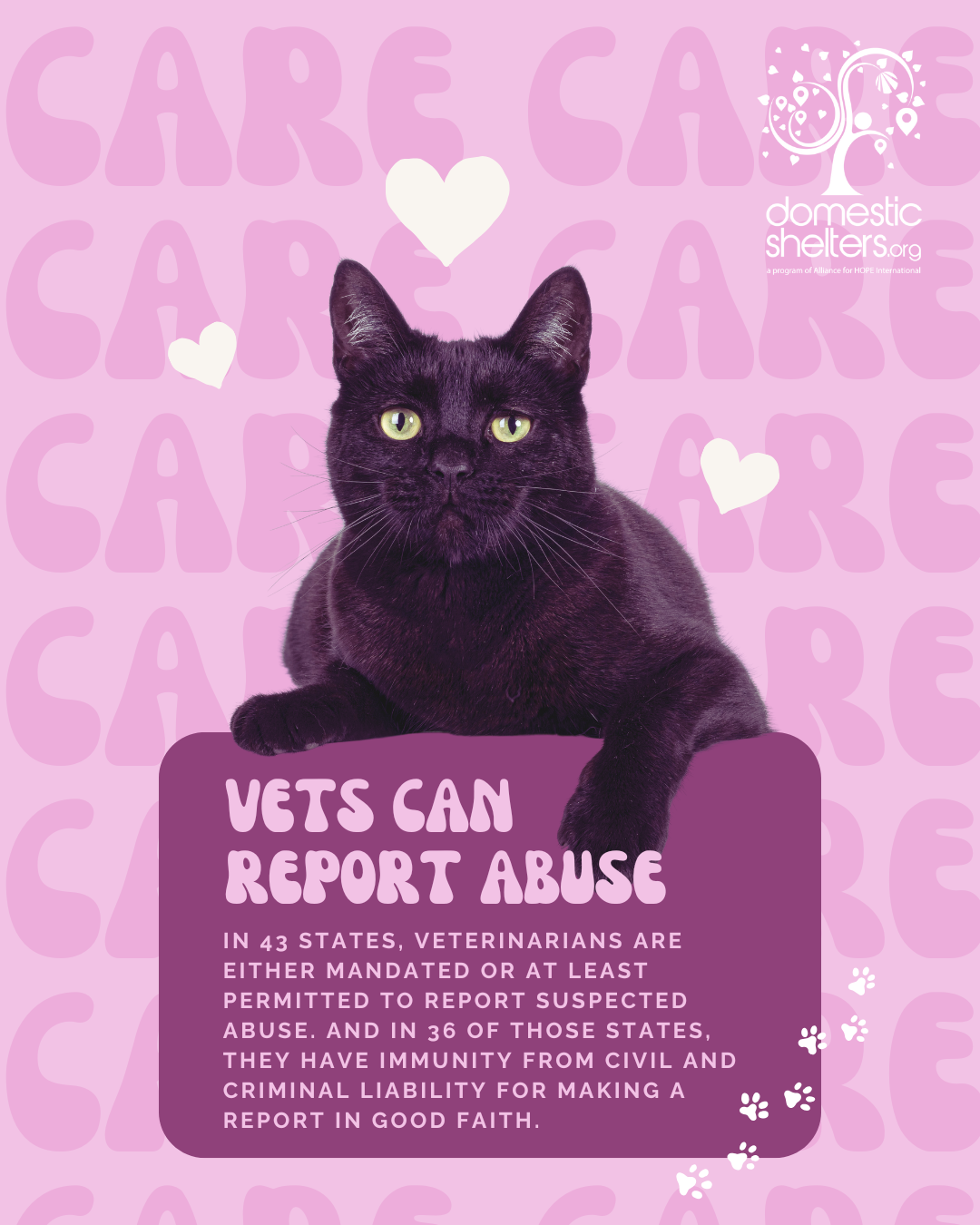
Arkow said, “We now have 43 states where veterinarians are either mandated or at least permitted to report suspected abuse. And in 36 of those states, they have immunity from civil and criminal liability for making a report in good faith. The veterinarian is the animal’s first line of defense. You have to make a report and hope the system works.”
Mandating reporting removes one roadblock. “Animal cruelty cases are not easy to diagnose and treat. They're always problematic. The veterinarian has an ethical dilemma as to whether her or his responsibilities are to the client or the patient,” Arkow says. “But if the law says that the vet has to report and could lose their license to practice if she or he doesn't, it makes it easier. It takes that dilemma off the table.”
If an animal comes in with significant weight loss, for example, a vet may not be able to tell whether that’s due to illness or food being withheld. Even if pets are sick, clients don’t always have the money to pay for advanced diagnostics like blood tests or imaging scans. So, it can be tough for vets to make a diagnosis.
“The veterinarian may fear reporting potential abuse when it’s actually physical disease,” Landis-Hanna says.
Vets can report something even if they aren’t sure. “We have to keep emphasizing [that] they don’t have to know that it’s abuse. They just have to see that something doesn’t match up,” Arkow says.
You might think reporting animal abuse would be straightforward, at least for people who work with animals. But there’s no national system for animal cruelty investigations. Only one state, Delaware, has a statewide system for reporting.
“It’s all handled on the purely local level. In any given city or county, it could be the police, the sheriff, the health department, believe it or not the fire department, animal services, animal control, a humane society or an SPCA,” Arkow says.
The National Link Coalition’s resource on reporting suspected abuse can help people find out what to do in their county, city or town.
Vets may be concerned that if they report abuse, abuse might get worse for that pet or members of that pet’s family. They may also be afraid that the abuser may harm staff members in the clinic. They may fear that reporting the abuse may make someone feel like their pet is too much trouble and that pet might end up in a shelter.
Fear of negative financial impact can influence decisions. If someone suspects their veterinarian has reported abuse, they may:
Veterinarians may not have deep pockets. Running a practice is expensive, and vets may be carrying a lot of debt. “There are many veterinarians who are paying their college loans until retirement, or who will postpone retirement due to six figures in college loans,” Landis-Hanna says.
Plus, if veterinarians lose clients, they need to consider the impact on the veterinary technicians, front desk staff and other people who count on them for income. “The veterinarian may prefer to err on the side of silence rather than risk bad things happening,” Landis-Hanna says.
Even though vets face barriers to reporting abuse, they are in a unique position to spot abuse that can be affecting both pets and families. “If they don't intervene, we know more bad things are going to happen,” Arkow says.
Landis-Hanna recommends speaking to someone on your veterinary team if you’re concerned about abuse. “Veterinarians are reliable and trustworthy. If you are fearful, at risk or being abused, whether your animal is being abused or not, please speak to the veterinary team,” she says. “Veterinary teams will always do their very best to protect not only the animals, but the humans as well.” Also, it's important to let your vet know if your pet is included within an existing order of protection against an abuser.
If you’re a veterinarian or pet care staff, and you’re concerned a client may be experiencing domestic violence, you can use our Get Help tool or talk to HopeChat in the bottom corner of your screen to find local advocates who can help.
Your support gives hope and help to victims of domestic violence every day.


Welcome, this is your discreet connection to help.
You are safe here.
Menstruation is an experience shared by
generations of women across the globe.
Sadly, abuse is another commonly shared experience between women.
Be it physical or psychological, abuse is not OK in any form.
Period.
You are not alone.
Help is just a few clicks away.
Welcome to DomesticShelters.org, a trusted Bright Sky US partner. On DomesticShelters.org, you will find free domestic violence resources such as:
The Bright Sky US website is still open on your browser in a separate tab, so you can return to the Bright Sky US website anytime.