1. Select a discrete app icon.








notes

In September of this year, 24-year-old Matthew Ruth—who had been stalking his ex-girlfriend—shot and killed three Pennsylvania detectives and injured two others who were trying to protect her. Ruth also fatally shot the woman’s dog before another officer was able to shoot and kill Ruth.
The case shed light on one of the most hazardous calls police routinely respond to—domestic violence cases. Between 2020 and September of 2024, the latest month data has been compiled by the FBI, 241 officers were feloniously killed in the line of duty, meaning their deaths were committed as the result of a dangerous crime.
The 54 officers killed in the first nine months of 2024 denote a 12.5 percent increase compared to the 48 officers killed during the same period the year prior. Guns were the weapon used to kill the majority of the officers who died in the line of duty.
While two of the officers’ deaths in 2024 are directly attributed to domestic disturbance calls, it’s possible domestic violence played a part in some of the other murders. Eighteen of the officers were killed while on investigative or enforcement calls, eight were killed in unprovoked attacks, six were ambushed, three were killed while in pursuit of a suspect and four were killed assisting other law enforcement officers.
For many abusers, a police call feels like the end — if they can’t control the victim anymore, they’ll try to control the ending.
In the case of Ruth’s ambush, neighbor Dave Miller told CNN he heard at least 30 gunshots. “It seemed like a war zone, sounded like a war zone,” he said.
Maybe it’s because Ruth had a semiautomatic AR-15-style rifle when he arrived at the farmhouse where his ex-girlfriend lived with her parents.
“We’re seeing an uptick in groups of officers killed because we’re seeing offenders with availability to these kinds of guns,” says Mark Wynn, former police officer who now trains officers in violence against women prevention. “There was a time when it was hard to get those kinds of weapons. Not anymore.”
While many factors are at play, the ease of gun access is certainly one of them. Despite legislation that attempts to take away guns from stalkers and abusive partners, many loopholes and workarounds exist. Unlicensed private gun sellers, darknet markets, and just hiding one’s weapons from police after an order of protection has been served (just ask Janet Paulsen about that) are just some of the ways that abusers who want to get a gun badly enough get weapons.
But beneath it all lies a deeper issue that always resurfaces in cases of domestic violence: the entitlement of abusers. And often, the only thing standing between an abuser and total control of their victim are the people who show up at the door to stop them.
“Abusers have a sense of entitlement. If I can’t have you, nobody else will,” says Wynn. “You [police] are standing between the victim and the offender.” Wynn says this is why so many victims of abuse are killed trying to get out.
“We generally respond to every [domestic violence] call prepared for something dangerous,” says Joe Bianco, Former San Diego Police Department detective, now the Law Enforcement Support Coordinator for Alliance for HOPE International.
Responding to domestic violence calls was a regular occurrence when he worked the beat in New York, responding to several a day.
“We are people coming in, backed by the authority of law, that can tell [the abusers] what to do and can take this woman away from [them],” says Bianco. “I don’t like people telling me what to do either, but these are the type of people who are unhinged when they’re told what to do.”
Incidents involving strangulation indicate a severe escalation of violence. Research consistently identifies strangulation as the leading predictor of homicide, a risk that extends beyond the victim to include law enforcement officers responding to the scene. For more information, read “What Law Enforcement Should Know About Strangulation.”
Wynn’s job is to educate police on responding to domestic violence calls. He says lethality risk assessments should always be the first step.
“I spend a lot of time talking to cops about this. You’ve got to understand that just because you got the [911] call, it isn’t the first time this happened. Our crisis line told us that victims call the crisis line, on average, after the fifth assault. So, context is important.”
Why do victims wait until the fifth assault? Many times, it’s because of a fear of repercussions from the abuser for reporting. The abuser has threatened the survivor that calling the police will result in more severe forms of abuse than staying silent. Other survivors are afraid the police won’t believe them, or that the abuser will flip the script, something called DARVO or deny, attack, reverse victim and offender. It’s a way abusers will redirect blame onto the survivor, sometimes resulting in the survivor herself being arrested.
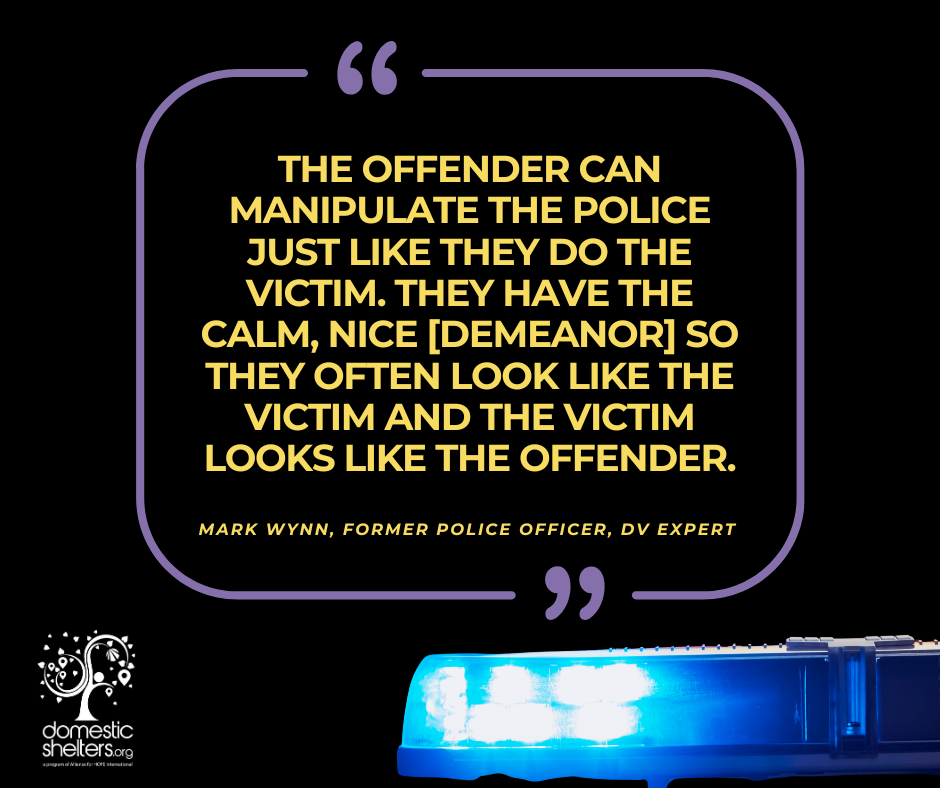
“The offender can manipulate the police just like they do the victim,” says Wynn. “They have the calm, nice [demeanor] so they often look like the victim and the victim looks like the offender.” But then, says Wynn, things can rapidly change when the abuser realizes this ploy won’t work.
“Very often when they think they’re going to jail, they fight back. Then it’s a free-for-all.”
He warns that many police officers face danger when they are serving orders of protection or arrest warrants or investigating violations of protection orders. The times when abusers don’t have an opportunity to argue their way out of something on the spot.
Such was the case for 23-year-old Pennsylvania State Trooper Landon Weaver who was killed barely six months out of the Academy by an abuser whom Weaver was investigating for violating a protection from abuse order in 2016. When Weaver found the perpetrator at his residence in a rural township, Weaver responded alone. The man shot and killed the young Trooper before fleeing the scene. He was tracked down the next day and, refusing to comply with officers’ orders to surrender, was shot and killed by police.
In more rural areas, Wynn says the problem is there is often only one police officer available to respond to each call.
Your support gives hope and help to victims of domestic violence every day.
“The offender knows they’re coming. They have plenty of time to prepare,” Wynn says. And often, it’s to prepare to fight back.
This is why Wynn says he encourages departments to analyze cases when officers are assaulted or killed to see what went wrong and how better to predict lethality risk in the future.
To learn more about lethality assessments, see our list of Domestic Violence Assessment Tools.

Welcome, this is your discreet connection to help.
You are safe here.
Menstruation is an experience shared by
generations of women across the globe.
Sadly, abuse is another commonly shared experience between women.
Be it physical or psychological, abuse is not OK in any form.
Period.
You are not alone.
Help is just a few clicks away.
Welcome to DomesticShelters.org, a trusted Bright Sky US partner. On DomesticShelters.org, you will find free domestic violence resources such as:
The Bright Sky US website is still open on your browser in a separate tab, so you can return to the Bright Sky US website anytime.


