1. Select a discrete app icon.








notes
This story was originally published in 2018. It was updated in 2026.
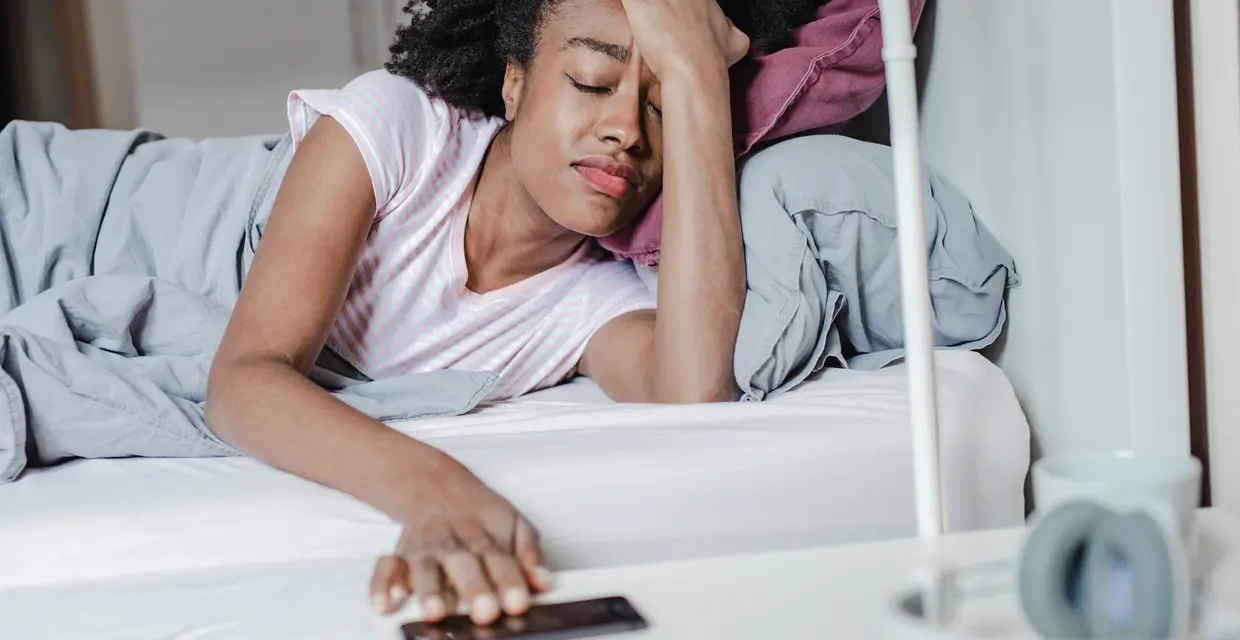
Abusers seem to always be coming up with new and cruel ways to exert power and control. Sleep deprivation is one of those ways. The tactic harkens back to their toddler days—what better way to get someone’s full and undivided attention than to keep them awake all night? Except this time, abusive partners don’t have the excuse of being 2 years old. They’re adults, and they’re throwing a tantrum in the middle of the night for a much different reason: they want you to suffer.
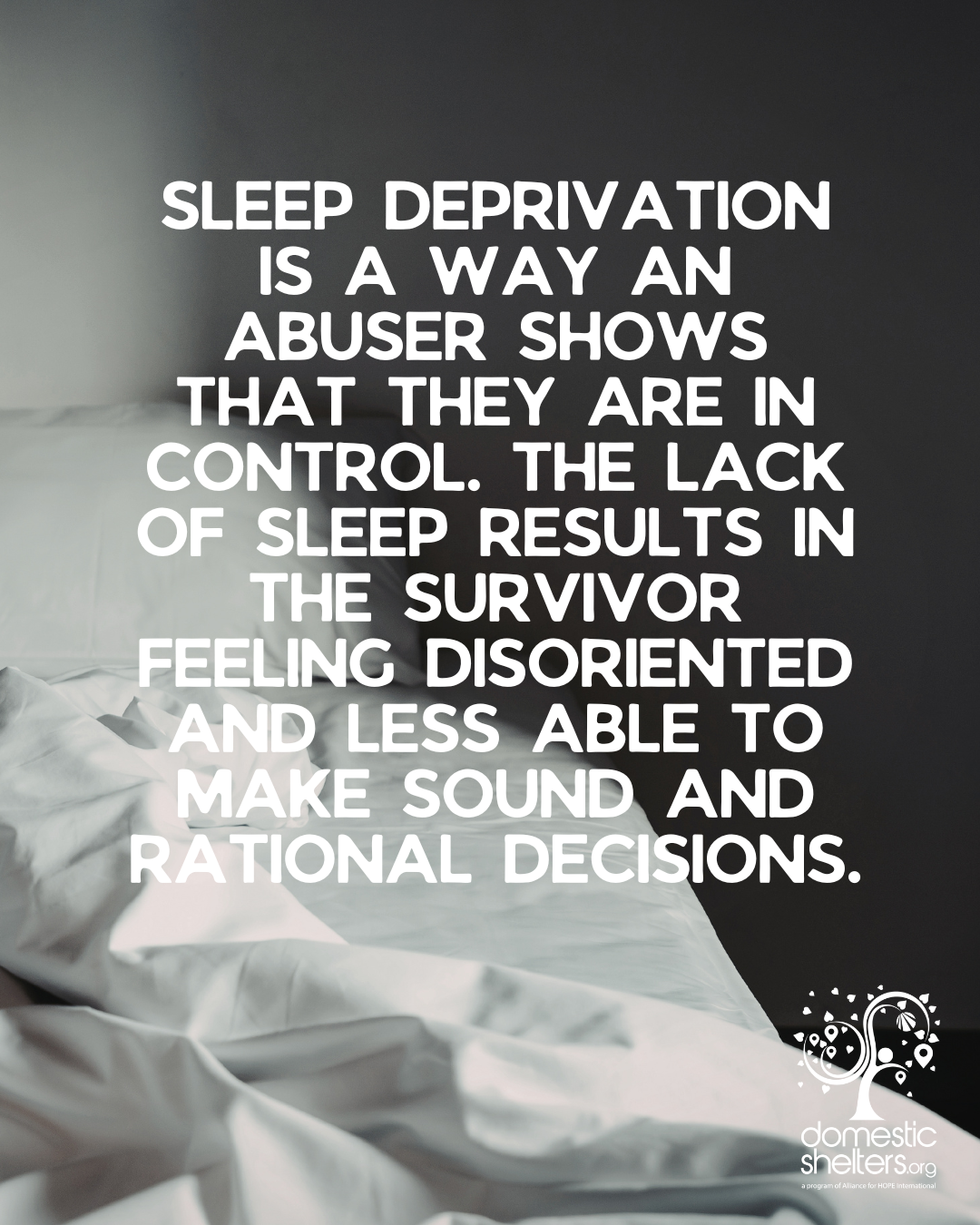
When an abuser goes out of their way to make sleep impossible for a survivor—not allowing a survivor to go to bed, punishing them with violence for falling asleep or waking them up at all hours of the night for no reason—yes, that’s abuse. They likely have some inkling that what they’re doing is cruel and unusual, but they continue to do it anyway, over and over, and often without remorse. Sleep deprivation serves multiple purposes: it’s a way an abuser shows that they are in control and the lack of sleep results in the survivor feeling disoriented and less able to make sound and rational decisions. All of this works in an abuser’s favor.
Mae Scott survived a marriage to an abusive partner who used sleep deprivation as one of his many abusive tactics. She says when she went to bed before her husband, he would turn on all the lights in their bedroom and rip the covers off her. He also used sleep deprivation as a tactic on their three children by pulling them out of bed in the middle of the night and sitting them on the couch. There, he would force them to listen as he berated their mother and threatened to leave the family unless they begged him to stay. Scott later wrote about her experience surviving abuse in her memoir, An Embarrassment of Pandas.
“The sleep deprivation tactic made it nearly impossible for me to get actual, restful sleep on any night, regardless of his behavior. I was always on high alert, and I don't think I ever fell into real REM sleep cycles,” says Scott. “The lack of regular, restorative sleep absolutely added to my confusion, and he loved to keep me confused. He loved the mind games and the power he had over my functioning.”
Scott says she never woke up feeling rested until her now ex-husband was behind bars, found guilty of felony assault after strangling her, among other charges.
Survivor Amy Thomson retells a similar but even more violent experience. Her abuser would wait until she was asleep before attacking her in bed.
“I would awaken to thunderous pain at the back of my head. He wouldn’t even wait for me to recover from the blow … he would just begin screaming at me as he paced back and forth, sometimes with a [weapon] in his hand.”
When she thought he was finally letting her sleep, she’d close her eyes, only for him to elbow her side or strike her in the stomach. Sometimes, he dumped water over her head.
“I was expected to stay awake the entire day following the incident. If he caught me falling asleep on the couch, he would ambush me again.”
The effects of sleep deprivation are cumulative. The longer you’re denied sleep, the greater the impact it can have on your mental and physical health.
The long-term effects of sleep deprivation can include:
Can sleep deprivation kill you? Not directly, but it can significantly raise your risk of dying over time. Even short-term sleep loss has been linked to higher risks of certain cancers, such as breast cancer, as well as Alzheimer’s disease, says Chris Brantner, certified sleep science coach. It also increases the likelihood of serious accidents. In other words, chronic sleep deprivation can have life-threatening consequences. These are consequences that an extra cup of coffee can’t fix. What’s needed is, simply, more sleep.
“You'll feel significantly better after a full night's sleep, but one of the biggest problems is that your circadian rhythm is going to be all out of whack,” says Bratner. “So, getting back to a point where you can get into a good sleep routine could take some time.”
A peaceful night’s sleep may be out of reach with an abuser who has a pattern of weaponizing sleep deprivation. A white noise machine and a good eye mask aren’t going to cut it here. Instead, you’re going to need help.
Also, you may want to consider safety planning with your children in case the abuser’s tactics escalate while they’re home.
If any of this sounds familiar, there are people ready to listen. Visit our Get Help page to connect with a local organization, or use Hope Chat at the bottom of your screen to explore other articles on similar topics and find support.
Your support gives hope and help to victims of domestic violence every day.

Welcome, this is your discreet connection to help.
You are safe here.
Menstruation is an experience shared by
generations of women across the globe.
Sadly, abuse is another commonly shared experience between women.
Be it physical or psychological, abuse is not OK in any form.
Period.
You are not alone.
Help is just a few clicks away.
Welcome to DomesticShelters.org, a trusted Bright Sky US partner. On DomesticShelters.org, you will find free domestic violence resources such as:
The Bright Sky US website is still open on your browser in a separate tab, so you can return to the Bright Sky US website anytime.


