1. Select a discrete app icon.








notes

Q: Someone close to me was killed by her abusive boyfriend. It feels like I’ll never stop being angry. I’m sad, too and sometimes I’m overwhelmed with emotions. I think people expect me to be over it by now, but I don’t feel over it at all. Is this normal? How can I move on?
A: I’m so sorry for your loss. It’s estimated that nearly 1,300 women are killed by their intimate partners every year in the U.S. That’s more than three a day whose lives are taken by boyfriends or husbands they once trusted. It’s understandable that you’re angry. We should all be outraged, frankly.
When it comes to grief, there is no one way to “get over” someone’s passing. What does it even mean to “get over” it anyhow? That sounds like a question people ask those who are grieving so that the question-asker can feel better about themselves, so that they can feel like their job checking in on you is complete.
A better goal might be getting to a place of healing where your loved one’s passing is something you can reflect on with sadness but also acceptance. A place where you can reflect on their life and its virtues instead of their death and its injustice. We’re told grief is supposed to be a linear process. We go through step one, then step two and pretty soon, we’re finished, like a To-Do list. We graduate from grief and move on, healed, to the next part of our life.
Unfortunately, that couldn’t be further from the truth.
When Elizabeth Kuber Ross created these five stages of grief in the 1960s—denial, anger, bargaining, depression and then acceptance—she was studying terminally ill patients. Kuber Ross meant for them to describe the process of dying, licensed social worker Katie Wangelin told me, much to my surprise. Ross didn’t mean those stages were ones someone else should go through dealing with losing another. But over the years they became misconstrued. So, we can go ahead and set those misunderstandings aside and restructure how we look at the grieving process.
Wangelin, who’s worked for more than 20 years in child and family bereavement, including within a Family Justice Center helping those who lost loved ones to violent domestic violence-related deaths, says grief should not be task-oriented. The analogy she prefers is to think of is waves that wash over you. Grief comes and goes without a clear end in sight. And I’m guessing—though Wangelin didn’t say this specifically, but I’ve been to the ocean enough times to discern this—grief could knock you over and flip you around as soon as you turn your back to it.
When Susan Altman lost her sister to domestic violence, people kept asking when she’d “get over it.” But what she was living wasn’t grief as most people understand it— it was trauma. It was not sleeping, overeating, missing her children’s milestones and screaming when her sister’s trial was delayed yet again. “That’s what grief looks like,” Altman tells me.
Stacy Feldman, Susan’s sister, was murdered in 2015 at the age of 44 by her husband Robert, who tried to make it appear like Stacy had slipped and fallen in the shower. It took three years, but he was finally arrested and charged with her murder.
“I don’t know how to put a word on what my life was between the murder and arrest. I don’t know if that was grief or trauma. I knew in my heart that she was murdered by her husband. I was on this path to get him arrested,” says Altman.
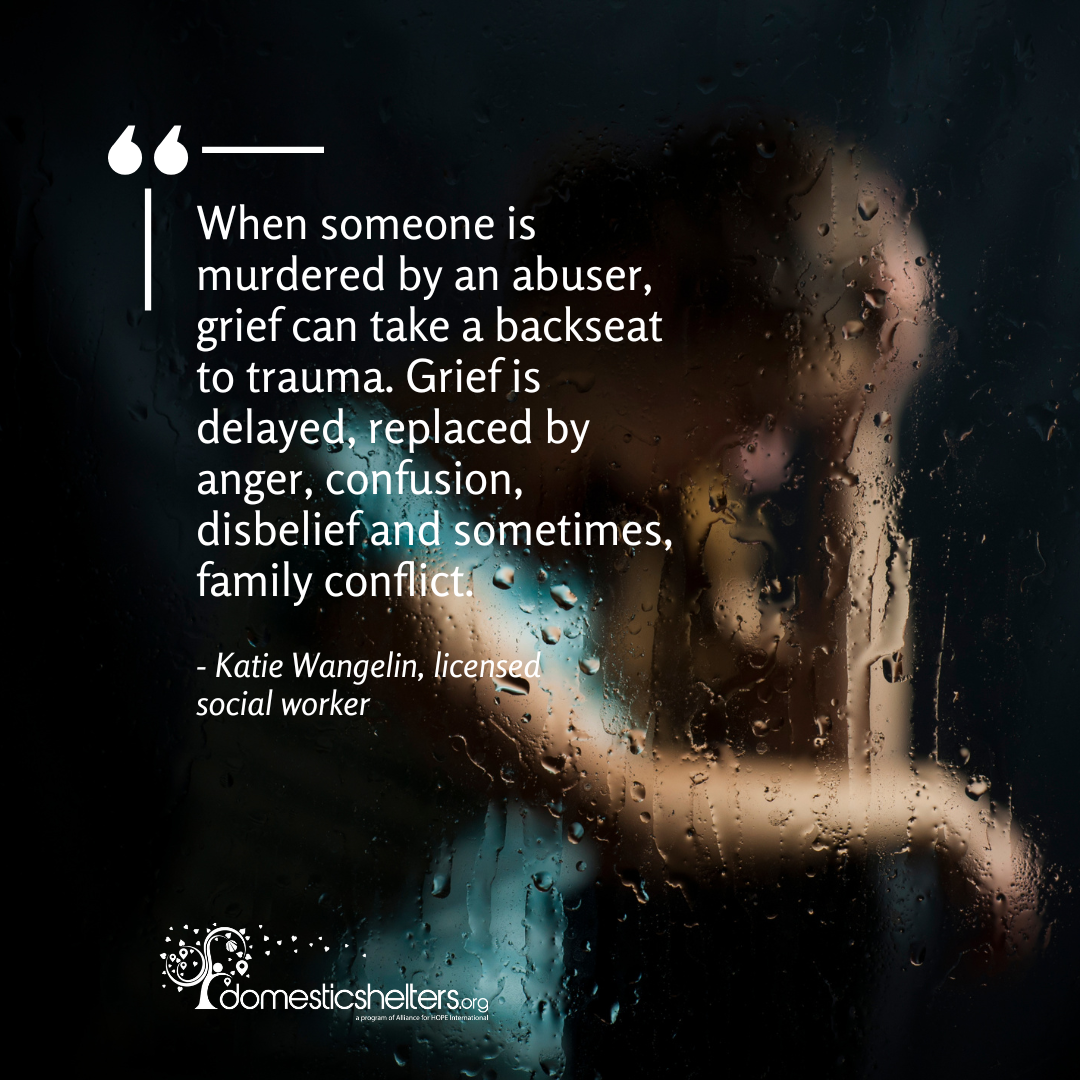
When someone is murdered by an abuser, grief can take a backseat to trauma, Wangelin explains. It’s different from anticipated loss, like a loved one dying from old age or extended illness.
“Grief almost gets postponed with so many technical and administrative matters.”
Those closest to the victim are often thrust into the criminal investigation, questioned by detectives and police. They may need to be present at court proceedings. There are other family members, like children, that may need to be kept safe. There are legal matters to attend to. Grief is delayed, replaced by anger, confusion, disbelief and sometimes, family conflict. In Altman’s case, not everyone was as laser-focused as she was on investigating her sister’s death as a murder.
“Family members flew in to try and convince me to give it up after a year,” she says. “I knew I wasn’t going to give up. She was my best friend. I will never have another person like that in my life.”
Even now, with Robert behind bars without the possibility of parole, Altman isn’t convinced she’s grieved her sister yet. But she does admit she felt something shift at the 10-year anniversary of her sister’s death.
“I woke up and felt different. I felt lighter and felt like I was more like myself. It was very remarkable.” Other people could notice, she says. She doesn’t know what changed.
“You can’t understand grief and trauma until you are in it. And I think it’s a really hard thing for the average person to have enough emotional intelligence to know what I was going through which is why it’s such an isolating place to be,” she says.
Wangelin says that for those grieving a death from domestic violence, by the time they’re getting to that hard work of processing the grief, “it can feel like the rest of the world has moved on. There’s a kind of disjointed, disconnected experience.”
She recommends counseling, something Altman sought out immediately following her sister’s death. Counseling saved her marriage, Altman explains.
Your support gives hope and help to victims of domestic violence every day.
Talking about your loved one can help. For Altman, every step of her advocacy work is a way to honor her sister and challenge the silence around domestic violence. In speaking out, she keeps [Stacy]’s voice in the world.
“I refer to [Stacy] in the present,” she says.
Here are a few other tips from Wangelin for getting “unstuck” in the grieving process:
You may also want to read a powerful first-person account of navigating grief in “Eat, Sleep, Breathe: Healing My Grieving Heart.”
Have a question for Ask Amanda? Message us on Facebook, X or email AskAmanda@DomesticShelters.org.
Ask Amanda is meant to offer helpful resources and information about domestic violence. If in crisis, please reach out to your nearest domestic violence shelter for the guidance of a trained advocate.

Welcome, this is your discreet connection to help.
You are safe here.
Menstruation is an experience shared by
generations of women across the globe.
Sadly, abuse is another commonly shared experience between women.
Be it physical or psychological, abuse is not OK in any form.
Period.
You are not alone.
Help is just a few clicks away.
Welcome to DomesticShelters.org, a trusted Bright Sky US partner. On DomesticShelters.org, you will find free domestic violence resources such as:
The Bright Sky US website is still open on your browser in a separate tab, so you can return to the Bright Sky US website anytime.


